CUETMOCK
  • Pricing
  • Mentors
Log inStart freeStart free mocks→

First test, then trust

Try a free CUET mock test.

Join 5,00,000+ students who rehearsed exam day on the exact NTA screen before sitting CUET. On the web and on Android.

Start free mocks →Get the Android app
CUETMOCK

India's #1 CUET Mock Test Platform. Original NCERT-based questions on the exact NTA exam screen — trusted by 5,00,000+ students since CUET 2022.

Get it onGoogle PlayScan to download the CUETMOCK app

Mock tests

  • CUET mock test series
  • Browse all papers
  • Commerce mocks
  • Humanities (Arts) mocks
  • Science mocks
  • Languages & GAT mocks
  • Free practice questions
  • Pricing

Resources

  • CUET exam guide
  • CUET syllabus
  • Universities accepting CUET
  • Expert blogs
  • News & notifications
  • Webinars & counselling
  • CUET score calculator
  • How we estimate your rank
  • FAQs

Company

  • About us
  • Our leadership & team
  • Our toppers
  • Mentors
  • For schools
  • Contact us
  • Terms
  • Privacy
  • Refund policy

Talk to us

+91 7696 6630 56info@cuetmock.comWhatsApp us

Our other platforms

  • JEE Mock — For IIT-JEE aspirants
  • NEET Mock — For NEET aspirants

Newsletter

Exam updates, study material and offers — no spam.

© 2026 NYC Ventures Pvt. Ltd.

701-702, Royal Business Park, Zirakpur, Punjab - 140603

  • Terms of use
  • Privacy policy
  • Refund policy
  • Contact us

iCUETMOCK is an independent preparation platform, not affiliated with the National Testing Agency (NTA). Always check exam details on the official NTA website.

  • Home
  • Mock tests
  • CUET guide
  • Pricing
  • Log in
Home/Practice questions/Sociology
SociologyIndian Society: Continuity and Change

Which of the following is true for Khasi society?

Which of the following is true for Khasi society?

Answer & explanation+

Correct answer: option 4

The correct answer is Option (4) → Structural tensions created by matrilineal system affect both men and women in Khasi society.

Option (1) Khasi women have more power than the men. — False. Khasi women inherit property from their mothers, but women possess only token authority; it is men who are the de facto power holders. Matriliny is not matriarchy.

Option (2) Men are confused beings and face inequality at the hands of Khasi women. — False. Men do face role conflict, torn between their natal house and their wife and children, but they wield the power. It is the women who are more adversely affected, because the system is more lenient to men.

Option (3) Man finds his sister’s home to be a more peaceful place than his own. — False. This turns a fear into a fact. It is the wife who can never be fully assured that her husband does not find his sister’s house a more congenial place; nothing says that men in general prefer it.

Option (4) Structural tensions created by matrilineal system affect both men and women in Khasi society. — True. Inheritance passes from mother to daughter, but control passes from the maternal uncle to the nephew. This separation creates structural tensions which affect both men and women: the man is torn between two houses, and the wife and the sister are both unsure of his commitment to them.

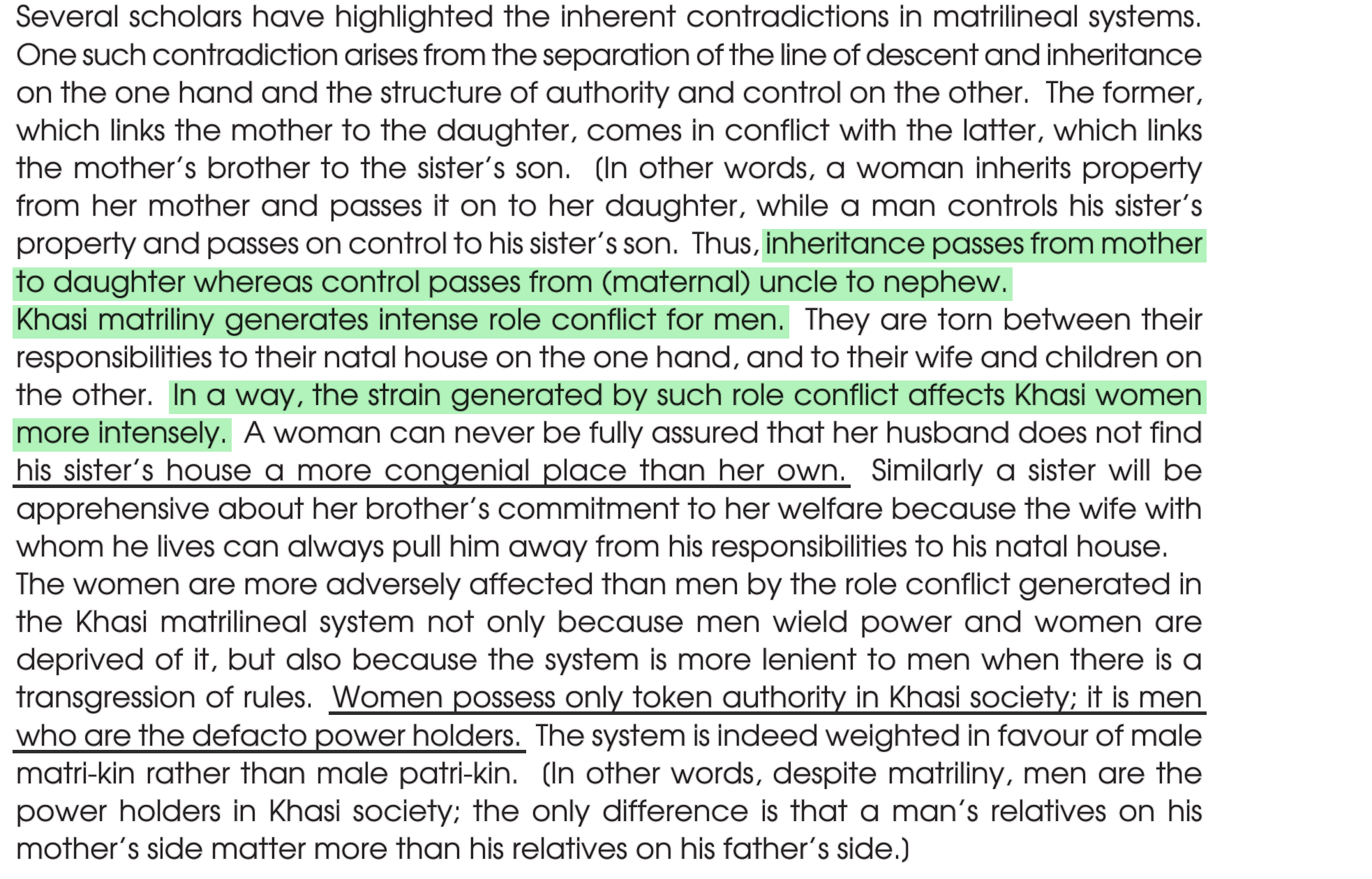
Note: Box 3.3 on the Khasi matrilineal family, and the lines that introduce it, in the chapter ‘Social Institutions: Continuity and Change’, were there in the pre-rationalised NCERT, which NTA followed in 2023. This portion has been deleted from the NCERT book (2025-26), though the chapter and its section on matriliny and matriarchy are still there.


NCERT (Pre-rationalised): “The Diverse Forms of the Family … However, there do exist matrilineal societies, i.e., societies where women inherit property from their mothers but do not exercise control over it, nor are they the decision makers in public affairs. The account of Khasi matriliny in Box 3.3 clarifies the distinction between matriliny and matriarchy. It shows the structural tensions created by matrilinear system which affect both men and women in Khasi society today.”

NCERT extract

Box 3.3, Khasi matrilineal family (Pre-rationalised NCERT)

Advertisement

Practise more on Indian Society: Continuity and Change

Chapter-wise mocks on the real NTA exam screen, with solutions and your rank. Your first mocks are free.

Start free mocks →

Advertisement

Next questions

  1. If the slope of a line passing through the points A(2, 1) and B(3, y) is 4, then the value of y will be:General Aptitude Test · Quantitative Reasoning
  2. In which year, did the era of Coalition Politics begin in India at the National Level?Political Science · Politics in India Since Independence: Recent Developments in Indian Politics
  3. Rearrange the given parts to form a meaningful sentence:- (A) societies, by providing knowledge, skills, and(B) be used to empower individu…English · Arrange in Meaningful Sequence
  4. Who among the following rulers of Mewar was defeated by Babur in the Battle of Khanwa (1527 AD)?General Aptitude Test · General Knowledge
  5. Anil, Ravi and Suresh invested Rs. 35,000, Rs. 40,000 and Rs. 75,000 respectively to start a business. At the end of 3 years, they earned a…Applied Maths. Section B2 · Financial Mathematics
  6. If products were sold by generic names, it would be very difficult for the marketers to distinguish their products from that of competitors…Entrepreneurship · Enterprise marketing
  7. Which of the following statements are correct: (A). In ideal solutions, the enthalpy of mixing of the pure components to form the solution…Chemistry · Physical: Solutions
  8. Which National Park among the following is the largest protected area in the Eastern Himalayan sub-region?General Aptitude Test · General Knowledge
  9. The term 'jins-i kamil' is generally used for ________.History · Medieval India: Peasants, Zamindars and the State
  10. What is the primary aim of Mission ShakthiSAT?English · Comprehension - (Narrative / Factual)