
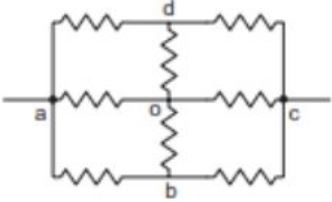
The equivalent resistance between the points a and c of the network shown in the figure, would be (Here each resistance is equal to r.)
Answer & explanation
Correct answer: option 2
The correct answer is Option (2) → $2r/3$
Set left terminal at potential $V$ and right at $0$. Let top, middle and bottom node potentials be $V_1,V_2,V_3$. By symmetry $V_1=V_3$, so write nodal equations (each resistor = $r$):
$3V_1 - V - V_2 = 0$
$4V_2 - V - 2V_1 = 0$
From the first $V_2 = 3V_1 - V$. Substitute into the second:
$4(3V_1 - V) - V - 2V_1 = 0 \;\Rightarrow\; 10V_1 - 5V = 0 \;\Rightarrow\; V_1 = \frac{V}{2}$
Thus $V_1=V_2=V_3=\frac{V}{2}$. Current from left to each node $= \frac{V-V_i}{r} = \frac{V}{2r}$. Total current $I = 3\cdot\frac{V}{2r} = \frac{3V}{2r}$.
Equivalent resistance $R_{eq} = \frac{V}{I} = \frac{V}{3V/(2r)} = \frac{2r}{3}$.
Therefore $R_{eq} = \frac{2r}{3}$.