Read the passage given below and answer the question.
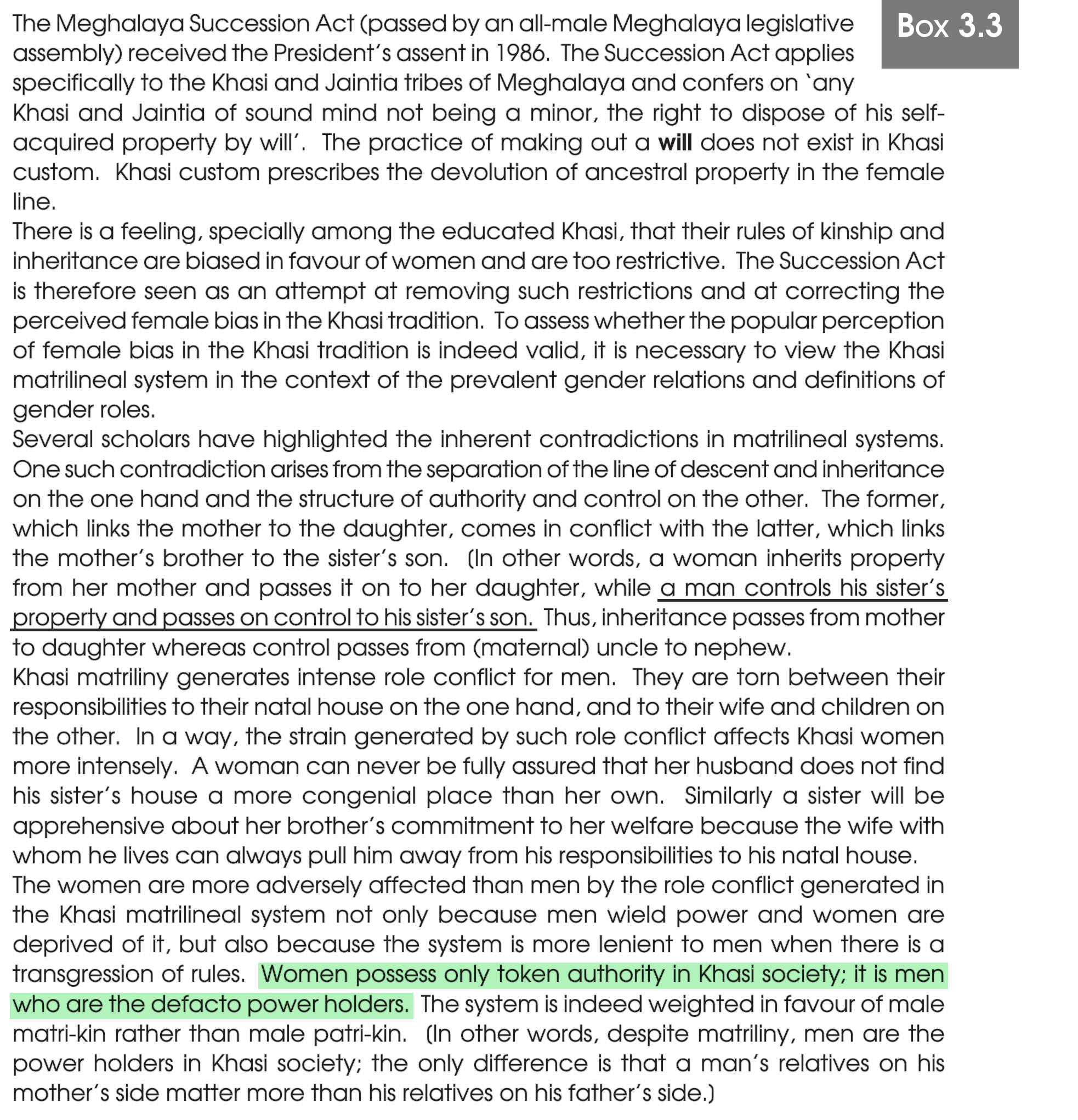
Khasi matriliny generates intense role conflict for men. They are torn between their responsibilities to their natal house on the one hand, and to their wife and children on the other. In a way, the strain generated by such role conflict affects Khasi women more intensely. A woman can never be fully assured that her husband does not find his sister's house a more congenial place than her own. Similarly a sister will be apprehensive about her brother's commitment to her welfare because the wife with whom he lives can always pull him away from his responsibilities to his natal house. The women are more adversely affected than men by the role conflict generated in the Khasi matrilineal system not only because men wield power and women are deprived of it, but also because the system is more lenient to men when there is a transgression of rules. Women possess only token authority in Khasi society; it is men who are the defacto power holders. The system is indeed weighted in favour of male matri-kin rather than male patri-kin. (In other words, despite matriliny, men are the power holders in Khasi society; the only difference is that a man's relatives on his mother's side matter more than his relatives on his father's side).
In context of Khasi matriliny identify the statement that truly reflects the position of women:
Answer & explanation
Correct answer: option 3
The correct answer is Option (3) → Women possess only token authority; it is men who are the defacto power holders
Option (1) Women enjoy a position of economic power as they inherit property — Incorrect. Khasi women do inherit property: it passes from mother to daughter. But control over that property passes from the maternal uncle to his nephew, because a man controls his sister’s property. So inheriting property does not give a Khasi woman economic power.
Option (2) Women enjoy a position of social powers as they live in a matrilineal society — Incorrect. A matrilineal society traces descent and passes on property through the mother, but in such societies women do not exercise control over the property, nor are they the decision makers in public affairs. The passage adds that Khasi women are more adversely affected than men by the system, which is more lenient to men when a rule is broken.
Option (3) Women possess only token authority; it is men who are the defacto power holders — Correct. ‘Token’ authority is authority in name only. The passage says this in so many words: despite matriliny, men are the power holders in Khasi society. The only difference from a patrilineal society is that a man’s relatives on his mother’s side (male matri-kin) matter more than those on his father’s side.
Option (4) Women enjoy unlimited power as it is a matriarchal society — Incorrect. A matriarchy would be a society where women are dominant. Khasi society is matrilineal, not matriarchal, and matriarchy has been a theoretical rather than an empirical concept: there is no historical or anthropological evidence of a society where women exercise dominance.
Note: Box 3.3 on the Khasi matrilineal family, in the chapter ‘Social Institutions: Continuity and Change’, was there in the pre-rationalised NCERT, which NTA followed in 2023. This box has been deleted from the NCERT book (2025-26), though the chapter and its section on matriliny and matriarchy (‘The Diverse Forms of the Family’) are still there.
NCERT (2025-26): “The Diverse Forms of the Family … With regard to the rules of inheritance, matrilineal societies pass on property from mother to daughter while patrilineal societies do so from father to son. A patriarchal family structure exists where the men exercise authority and dominance, and matriarchy where the women play a similarly dominant role. However, matriarchy – unlike patriarchy – has been a theoretical rather than an empirical concept. There is no historical or anthropological evidence of matriarchy – i.e., societies where women exercise dominance. However, there do exist matrilineal societies, i.e., societies where women inherit property from their mothers but do not exercise control over it, nor are they the decision makers in public affairs.”
Box 3.3, Social Institutions: Continuity and Change (Pre-rationalised NCERT) |