How does progressive muscular relaxation work in reducing anxiety?
Answer & explanation
Correct answer: option 3
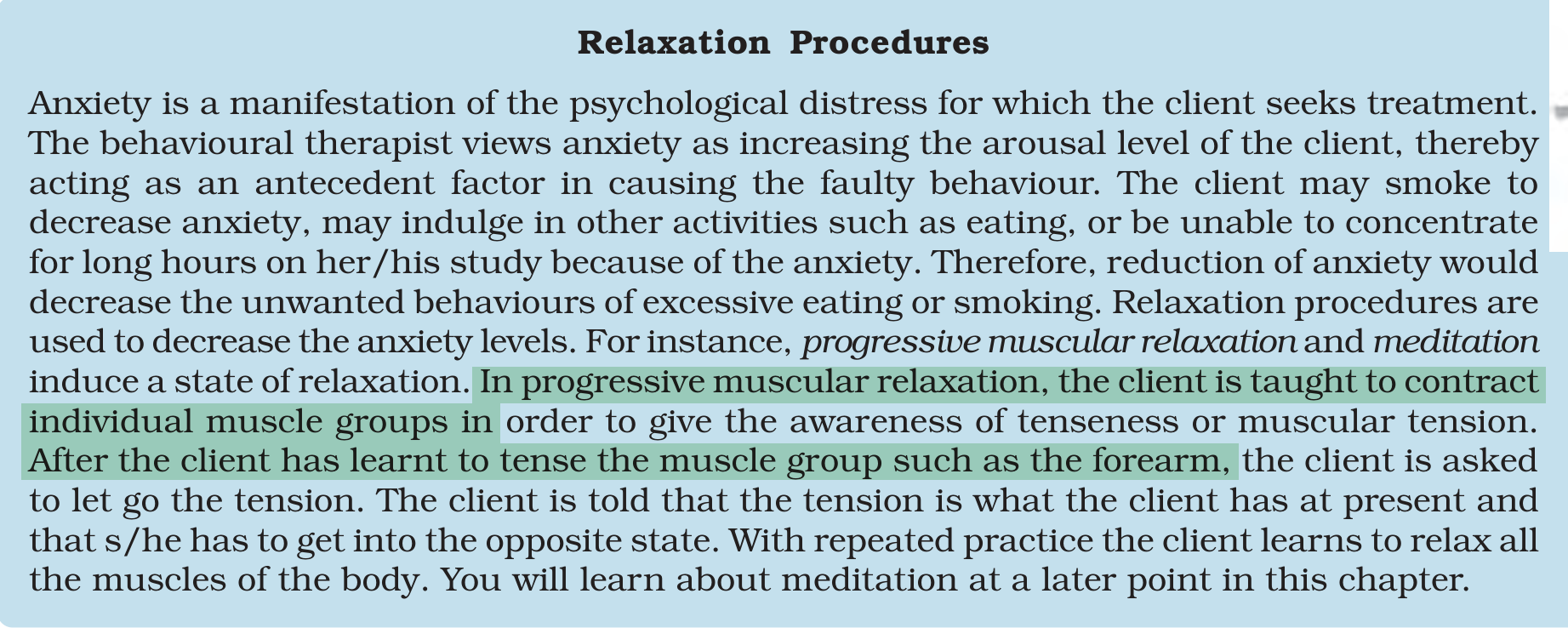
The correct answer is Option (3) → By teaching the client to let go of muscle tension
| Option | Reason |
|---|---|
| Option (1): By rewarding each wanted behaviour with tokens that are later exchanged for a treat. Incorrect. | Giving a token every time a wanted behaviour occurs is token economy. The tokens are collected and exchanged for a reward such as an outing for the patient or a treat for the child. |
| Option (2): By repeatedly pairing the unwanted response with an aversive consequence. Incorrect. | This is aversive conditioning. An alcoholic is given a mild electric shock while asked to smell alcohol, so with repeated pairings the smell itself turns aversive and the person gives up alcohol. |
| Option (3): By teaching the client to let go of muscle tension. Correct. | After learning to tense a muscle group such as the forearm, the client is asked to let go the tension and get into the opposite state. With repeated practice the client learns to relax all the muscles of the body, so the arousal level comes down and anxiety falls. |
| Option (4): By increasing the awareness of psychological distress. Incorrect. | Psychological distress is the state the client seeks treatment for, and anxiety is one of its manifestations. The therapist brings it into view through behavioural analysis of the client's behaviour patterns. |
NCERT (2026-27):
|