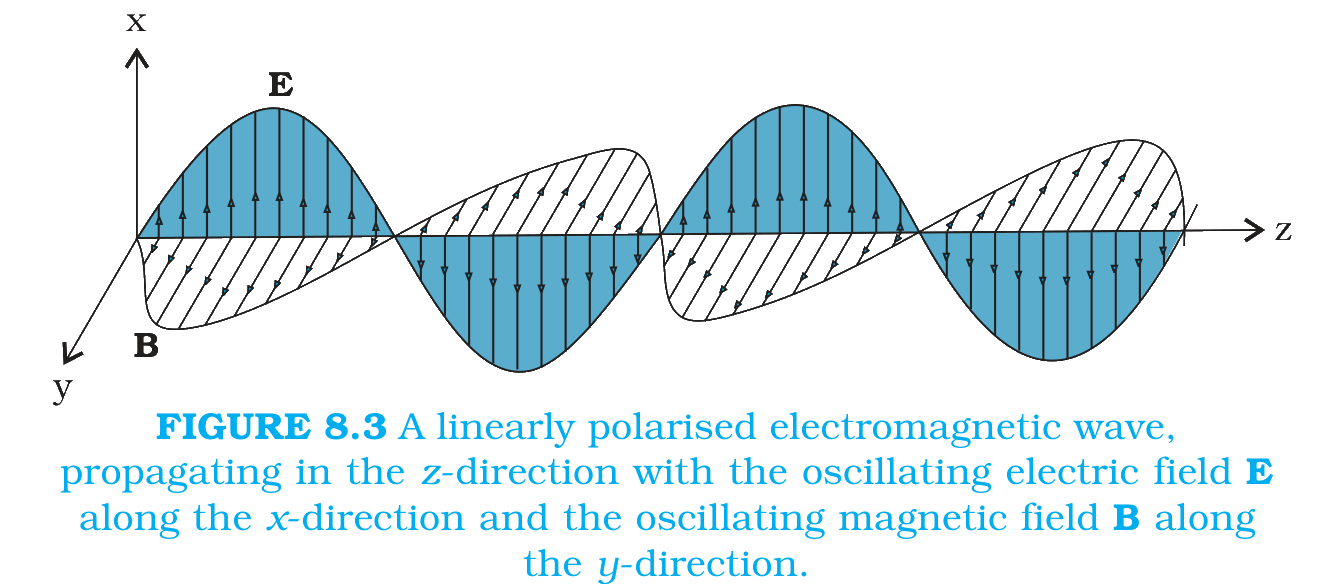
A plane electromagnetic wave travels in vacuum along the z-axis. Its electric field \(E_x\) and magnetic field \(B_y\) are plotted against \(z\) at one instant. Which of the following describes the two curves correctly?
Answer & explanation
Correct answer: option 4
The correct answer is Option (4) → They are in phase and lie in mutually perpendicular planes.
In a plane wave along z, both fields vary as \( \sin(kz-\omega t) \) with the same \( k \) and \( \omega \). So they reach their maximum and zero values at the same points. Such curves are in phase.
Option (1) They are in phase, but the wavelength of \(B_y\) is half that of \(E_x\). — Incorrect. Both fields have the same \( k \). So they have the same wavelength, \( \lambda=2\pi/k \).
Option (2) They lie in perpendicular planes, but \(B_y\) is maximum where \(E_x\) is zero. — Incorrect. The planes are perpendicular, but the phase is the same. Wherever \( E_x \) is zero, \( B_y \) is also zero.
Option (3) They are in phase and lie in the same plane. — Incorrect. \( E_x \) is along the x-axis and \( B_y \) is along the y-axis. So the two curves lie in the xz and yz planes, which are perpendicular.
Option (4) They are in phase and lie in mutually perpendicular planes. — Correct. Both fields have the same phase \( (kz-\omega t) \). They are perpendicular to each other and to the direction of travel.
NCERT (2026-27):
Nature of electromagnetic waves – “In Fig. 8.3, we show a typical example of a plane electromagnetic wave propagating along the z direction (the fields are shown as a function of the z coordinate, at a given time t). The electric field Ex is along the x-axis, and varies sinusoidally with z, at a given time. The magnetic field By is along the y-axis, and again varies sinusoidally with z. The electric and magnetic fields Ex and By are perpendicular to each other, and to the direction z of propagation. We can write Ex and By as follows:”
\( E_x=E_0\sin(kz-\omega t) \qquad B_y=B_0\sin(kz-\omega t) \)\( \qquad [8.7(a), (b)] \)