
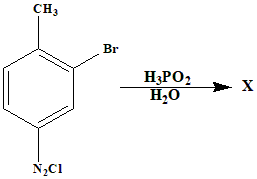
Identify\('X'\)
Answer & explanation
Correct answer: option 4
The correct answer is Option (4) → o-Bromotoluene (2-bromotoluene)
Mild reducing agents such as hypophosphorous acid (H3PO2) or ethanol reduce a diazonium salt to the arene: the –\( \ce{N2^{+}Cl^{-}} \) group is replaced by H, and nitrogen escapes. The other ring substituents are not touched.
\( \ce{ArN2Cl + H3PO2 + H2O -> ArH + N2 + H3PO3 + HCl} \)
The starting compound has \( \ce{CH3} \) at C-1, Br at C-2 and \( \ce{N2Cl} \) at C-4. Removing the diazonium group leaves \( \ce{CH3} \) and Br on adjacent carbons: X is 2-bromotoluene.
Why the other options are incorrect
Option (1) — Incorrect. Br replaced by OH and the \( \ce{N2Cl} \) group kept; \( \ce{H3PO2} \) acts on the diazonium group, not on the C–Br bond.
Option (2) — Incorrect. \( \ce{CH3} \) and Br both changed to OH with \( \ce{N2Cl} \) still present; none of these changes is caused by \( \ce{H3PO2} \).
Option (3) o-cresol — Incorrect. Warming a diazonium salt with water gives a phenol at the diazonium position; here OH appears in place of Br, which does not happen.
NCERT (2026-27 edition):
Replacement by H
