Select the correct statements about double salts:
A. K4 [Fe(CN)6] is an example of double salt.
B. KAl(SO4)2.12H2O is an example of double salt.
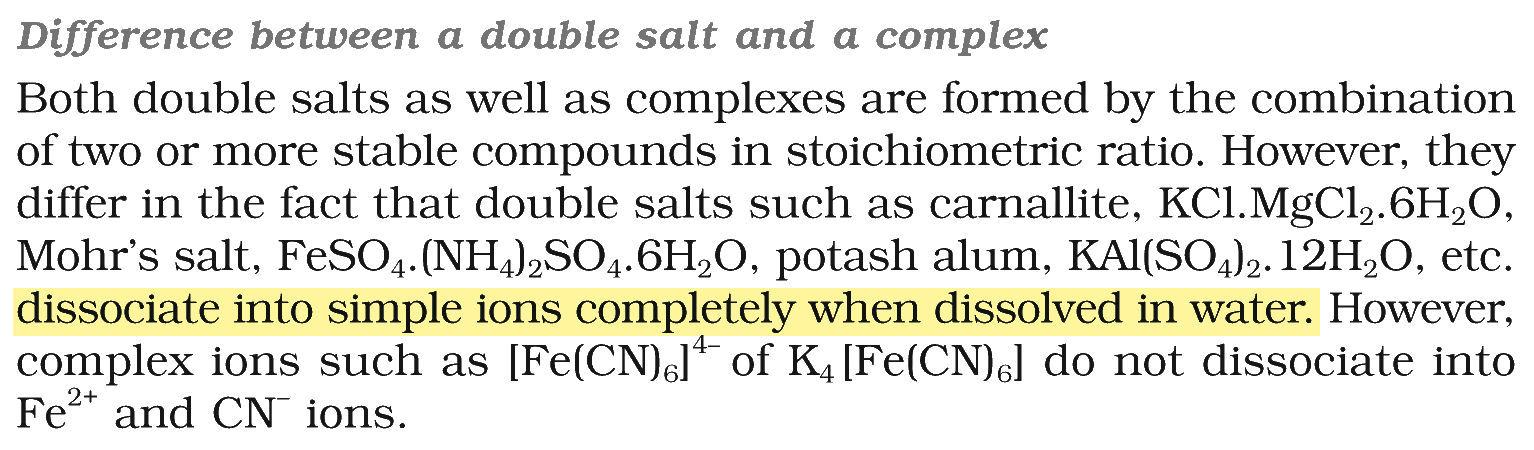
C. Double salts dissociate completely into simple ions when dissolved in water.
D. Double salts are non-stoichiometric compounds
Choose the correct answer from the options given below:
Answer & explanation
Correct answer: option 3
The correct answer is Option (3) → B and C only
A double salt dissociates completely into simple ions in water, while a complex compound keeps its complex ion intact.
A. K4 [Fe(CN)6] is an example of double salt. — Incorrect. It is a complex compound; the \( \ce{[Fe(CN)6]^{4-}} \) ion does not break into \( \ce{Fe^{2+}} \) and \( \ce{CN^{-}} \).
\( \displaystyle \ce{K4[Fe(CN)6] -> 4K+ + [Fe(CN)6]^4-} \)
B. KAl(SO4)2.12H2O is an example of double salt. — Correct. Potash alum gives only simple ions in water.
\( \displaystyle \ce{KAl(SO4)2.12H2O -> K+ + Al^3+ + 2SO4^2- + 12H2O} \)
C. Double salts dissociate completely into simple ions when dissolved in water. — Correct. This is what separates double salts from complexes.
D. Double salts are non-stoichiometric compounds — Incorrect. The salts combine in a fixed (stoichiometric) ratio.
NCERT (2026-27 edition):
Difference between a Double Salt and a Complex