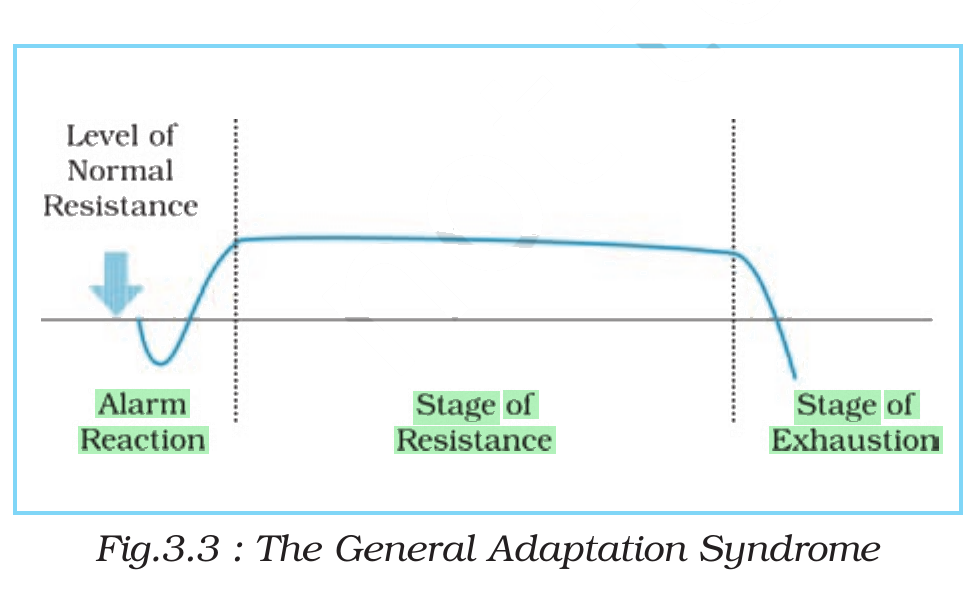
Hans Selye studied the bodily responses to prolonged stress and developed General Adaptation Syndrome involving three stages. Arrange the below mentioned statements in order.
A. The parasympathetic nervous system calls for more cautious use of the body’s resources.
B. This triggers the release of hormones and person is ready for fight or flight
C. The organism makes efforts to cope with the threat as through confrontations.
D. The physiological system involved in alarm reaction and resistance becomes ineffective.
E. Presence of a noxious stimuli or stressor leads to the activation of adrenal-pituitary-cortex system.
Choose the correct answer from the options given below:
Answer & explanation
Correct answer: option 3
The correct answer is Option (3) → EBACD
Selye called the common pattern of bodily response to prolonged stress the General Adaptation Syndrome, with three stages: alarm reaction, resistance and exhaustion.
(E) Presence of a noxious stimuli or stressor leads to the activation of adrenal-pituitary-cortex system. — the alarm reaction stage begins with the stressor activating this system.
(B) This triggers the release of hormones and person is ready for fight or flight — still the alarm reaction: the activation releases the hormones of the stress response.
(A) The parasympathetic nervous system calls for more cautious use of the body’s resources. — if stress is prolonged, the resistance stage begins with this step.
(C) The organism makes efforts to cope with the threat as through confrontations. — the rest of the resistance stage: the organism tries to cope with the threat.
(D) The physiological system involved in alarm reaction and resistance becomes ineffective. — continued exposure leads to the exhaustion stage, and susceptibility to stress-related diseases increases.
NCERT (2025-26): “General Adaptation Syndrome … He called this pattern the General Adaptation Syndrome (GAS). According to him, GAS involves three stages: alarm reaction, resistance, and exhaustion (see Fig.3.3).
|