Read the passage carefully and answer the questions.
Replacement of a hydrogen atom in a hydrocarbon by an alkoxy or carboxyl group yields a class of compounds known as ethers. Ethers are classified as symmetrical or unsymmetrical on the basis of groups attached to the oxygen atoms. Diethyl ether, a symmetrical ether, has been widely used as an inhalation anesthetic. Ethers can be prepared by acid catalyzed intermolecular dehydration of alcohols and Williamson's synthesis. Acid catalyzed dehydration of alcohols is not generally preferred as it gives a mixture of elimination and substitution products. In Williamson's synthesis, an alkyl halide is allowed to react with sodium alkoxide. Ethers containing substituted Alkyl groups may also be prepared by this method. The C-O bond in ether is weakly polar and is cleaved under drastic conditions with excess of hydrogen halides. In electrophilic substitution, the alkoxy group deactivates the aromatic ring and directs the incoming group to ortho and para positions.
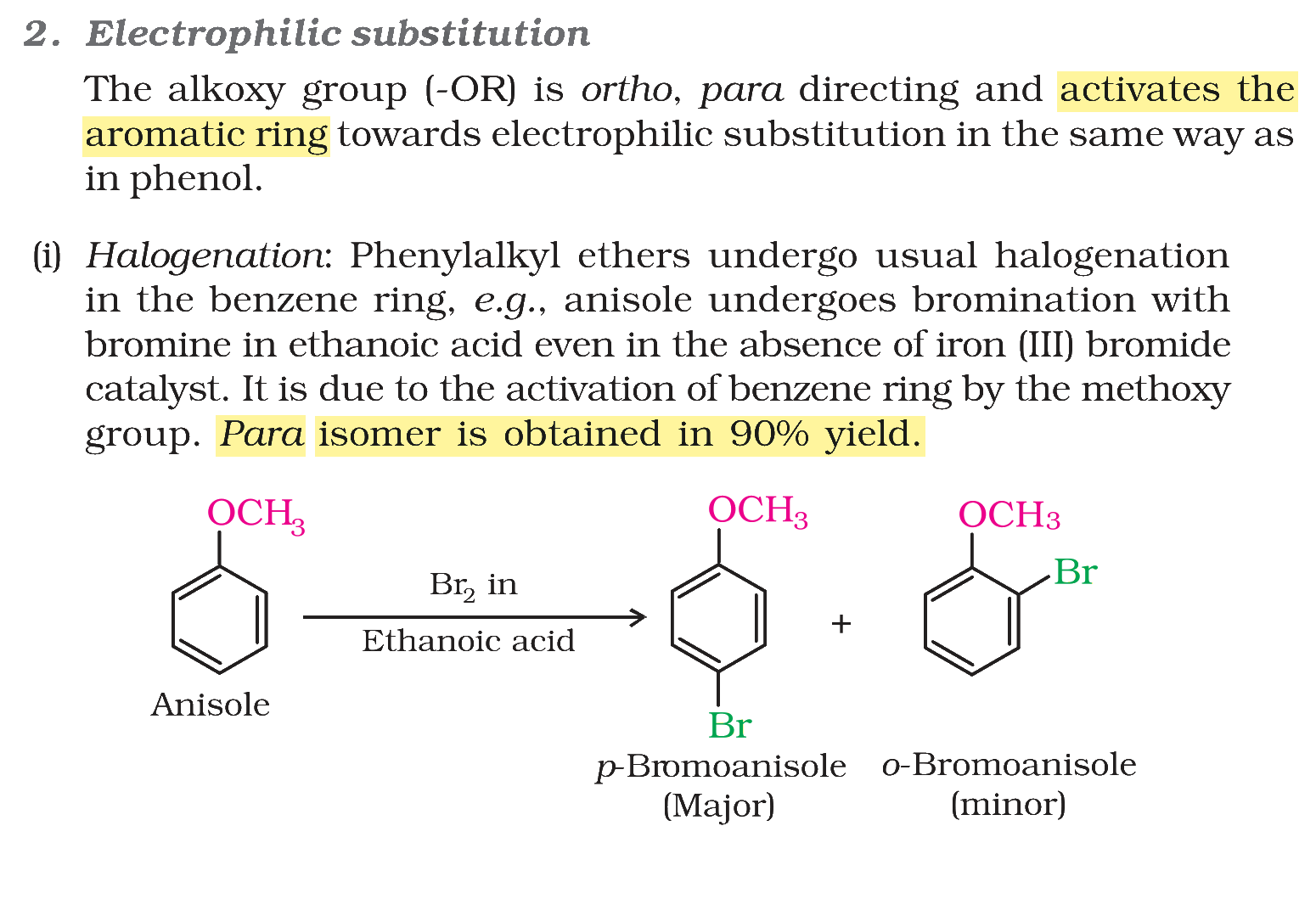
The major product in the reaction of anisole with bromine in ethanoic acid, is:
Answer & explanation
Correct answer: option 2
The correct answer is Option (2) → p-bromoanisole
The methoxy group of anisole donates electron density into the benzene ring by resonance. This activates the ring towards electrophilic substitution and directs the incoming electrophile to the ortho and para positions. The ring is so activated that bromine in ethanoic acid brominates it even without the iron(III) bromide catalyst that benzene itself needs.
Both the ortho and the para isomers are formed, but the bulky –\( \ce{OCH3} \) group crowds the two ortho positions next to it. The electrophile therefore attacks mainly at the free para position, so p-bromoanisole is the major product (about 90%):
\( \displaystyle \ce{C6H5OCH3 + Br2} \xrightarrow{\text{ethanoic acid}} p\text{-}\ce{BrC6H4OCH3}\,(\text{major}) + o\text{-}\ce{BrC6H4OCH3}\,(\text{minor}) + \ce{HBr} \)
Why the other options are incorrect
Option (1) o-bromoanisole — Incorrect. It is formed, but only as the minor product, because the ortho positions are hindered by the methoxy group.
Option (3) m-bromoanisole — Incorrect. The –\( \ce{OCH3} \) group is an ortho/para director; resonance does not raise the electron density at the meta positions, so the meta isomer is not obtained.
Option (4) o-bromoanisole and p-bromoanisole — Incorrect. Both isomers are formed, but the question asks for the major product, which is the para isomer alone.
Note: It seems that there is a mistake in the original NTA paper, which prints alkoxy or carboxyl group when it should read alkoxy or aryloxy group, and deactivates when it should read activates.
NCERT (2026-27 edition):
Electrophilic Substitution