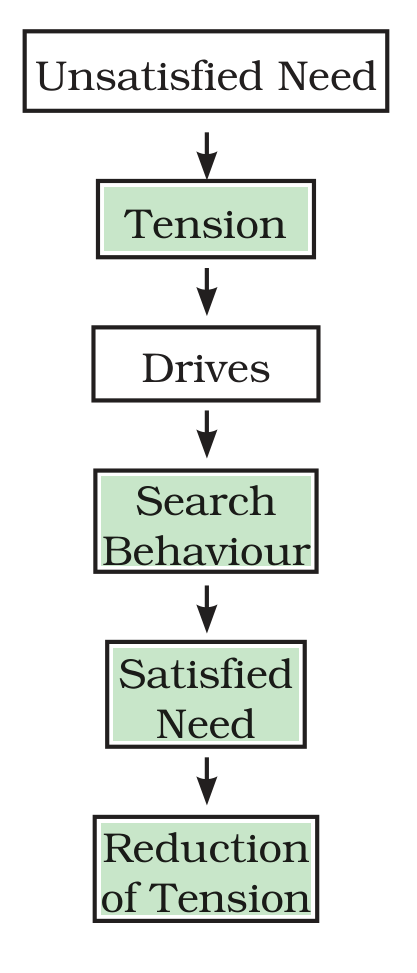
Arjun skipped his breakfast. Match List-I (stages of the motivation process) with List-II (what happens to Arjun):
| List-I | List-II | ||
|---|---|---|---|
| (A) | Tension | (I) | He walks two kilometres looking for a place that serves meals. |
| (B) | Search behaviour | (II) | He eats a full meal of roti and dal at a hotel. |
| (C) | Satisfied need | (III) | By one o’clock he becomes restless. |
| (D) | Reduction of tension | (IV) | After the meal he feels that he has regained energy. |
Choose the correct answer from the options given below:
Answer & explanation
Correct answer: option 3
The correct answer is Option (3) → (A)-(III), (B)-(I), (C)-(II), (D)-(IV)
| List-I | List-II | Reason |
|---|---|---|
| (A) Tension | (III) By one o’clock he becomes restless. | An unsatisfied need creates tension. Arjun’s hunger makes him restless. |
| (B) Search behaviour | (I) He walks two kilometres looking for a place that serves meals. | Tension stirs drives, and the drives make a person search for a way to meet the need. |
| (C) Satisfied need | (II) He eats a full meal of roti and dal at a hotel. | Eating the meal meets the need for food. |
| (D) Reduction of tension | (IV) After the meal he feels that he has regained energy. | Once the need is met, the person is relieved of tension. Feeling his energy come back follows the meal. |
NCERT (2026-27 Edition): “Motivation Process: Motivation process is based on human needs. A simple model to explain motivation process is presented below.” “The following example explains the process of satisfaction of human needs.” “Ramu is very hungry since he did not have breakfast in the morning. By 1.00 P.M., he became restless and started walking on the road in search of a hotel for snacks or meals. After walking for 2 kms, he could find a hotel where roti and dal was available for ₹ 10. Since he had only ₹ 15 in his pocket, he paid ₹ 10 and had a satisfying meal. After taking a meal, he felt that he had regained energy.” “An unsatisfied need of an individual creates tension which stimulates his or her drives. These drives generate a search behaviour to satisfy such need. If such need is satisfied, the individual is relieved of tension.”
|