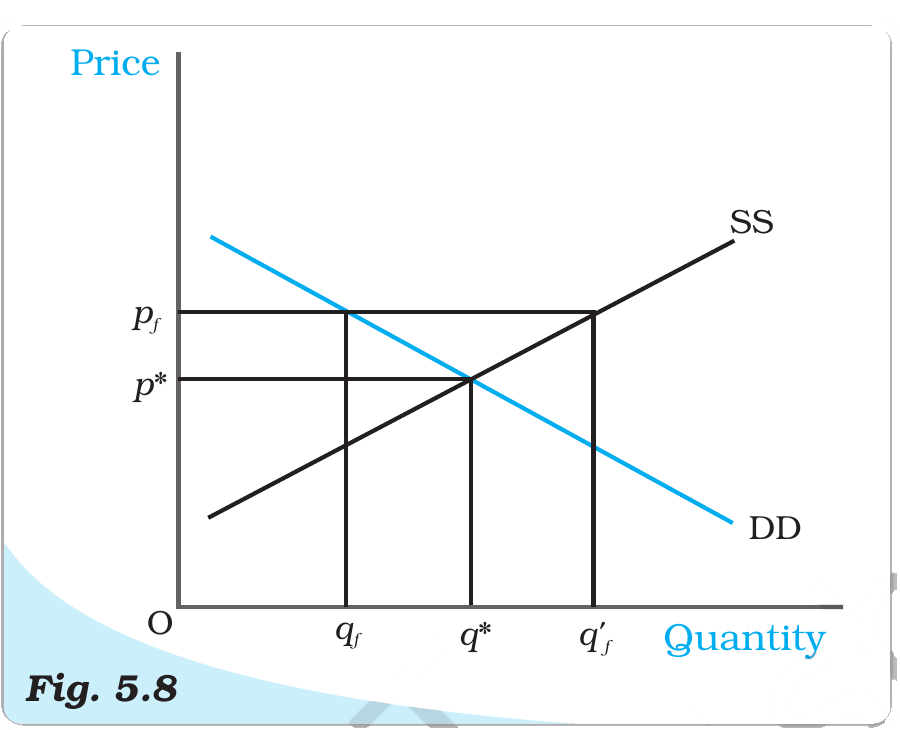
Suppose the government sets a price for agricultural goods in the market. The market would react unless measures are taken by the government to maintain the price. Arrange the correct sequence for the procedure.
A. There would be excess supply in the market.
B. The government needs to buy the surplus at a pre-determined price.
C. The prices would fall.
D. Prices for agricultural goods are set higher than the market price by the government.
Choose the correct answer from the options given below:
Answer & explanation
Correct answer: option 3
The correct answer is Option (3) → D, A, C, B
Left to itself, a market settles at the equilibrium price, where the quantity farmers offer equals the quantity buyers want. To protect farmers’ incomes, the government may fix a minimum price for a crop above this level: a price floor, or support price. A price above equilibrium upsets the balance between the two sides of the market, and the floor lasts only if the government itself takes part in the market:
D. Prices for agricultural goods are set higher than the market price by the government. — the government fixes the floor above the equilibrium price.
A. There would be excess supply in the market. — at the higher price farmers want to sell more and buyers want to buy less, so the quantity supplied exceeds the quantity demanded.
C. The prices would fall. — left alone, sellers with unsold stock would cut their prices, pushing the price back below the floor.
B. The government needs to buy the surplus at a pre-determined price. — to stop the price from falling, the government itself buys the excess supply at the support price, and the floor holds.
NCERT (2025-26): “5.2.2 Price Floor … For certain goods and services, fall in price below a particular level is not desirable and hence the government sets floors or minimum prices for these goods and services. The government-imposed lower limit on the price that may be charged for a particular good or service is called price floor. Most well-known examples of imposition of price floor are agricultural price support programmes and the minimum wage legislation. Through an agricultural price support programme, the government imposes a lower limit on the purchase price for some of the agricultural goods and the floor is normally set at a level higher than the market-determined price for these goods.… …Figure 5.8 shows the market supply and the market demand curve for a commodity on which price floor is imposed.… …In the case of agricultural support, to prevent price from falling because of excess supply, government needs to buy the surplus at the predetermined price.…”
|