
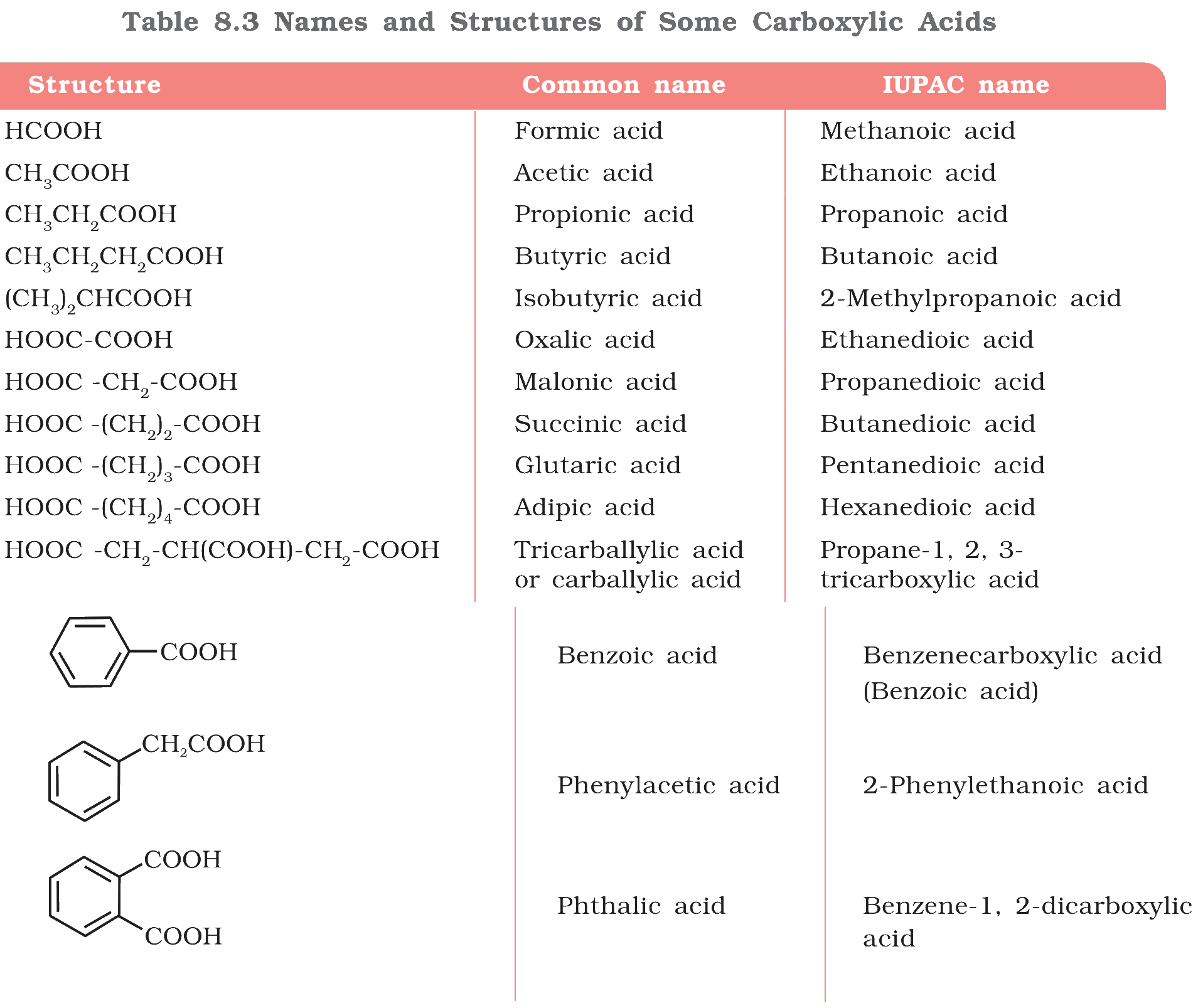
The table gives the structures, common names and IUPAC names of some carboxylic acids.
One acid of the table was first obtained from rancid butter, and its common name comes from the Latin word for butter, butyrum. What is the IUPAC name of this acid?
Answer & explanation
Correct answer: option 3
The correct answer is Option (3) → Butanoic acid
The common names of carboxylic acids end in –ic acid and come from the Latin or Greek names of their natural sources. The acid from butter (butyrum) is butyric acid. In the table its structure is \( \ce{CH3CH2CH2COOH} \), an unbranched chain of four carbon atoms, and its IUPAC name, in the same row, is butanoic acid.
Why the other options are incorrect
Option (1) Methanoic acid — Incorrect. This is formic acid, \( \ce{HCOOH} \), named from red ants (Latin formica).
Option (2) 2-Methylpropanoic acid — Incorrect. This is isobutyric acid, \( \ce{(CH3)2CHCOOH} \), the branched acid of the next row; the acid from butter is the unbranched one.
Option (4) Propanoic acid — Incorrect. This is propionic acid, \( \ce{CH3CH2COOH} \), with three carbon atoms.
NCERT (2026-27 edition):
8.6.1 Nomenclature – “Since carboxylic acids are amongst the earliest organic compounds to be isolated from nature, a large number of them are known by their common names. The common names end with the suffix –ic acid and have been derived from Latin or Greek names of their natural sources. For example, formic acid (HCOOH) was first obtained from red ants (Latin: formica means ant), acetic acid (CH3COOH) from vinegar (Latin: acetum, means vinegar), butyric acid (CH3CH2CH2COOH) from rancid butter (Latin: butyrum, means butter).”
Table 8.3: Names and Structures of Some Carboxylic Acids