
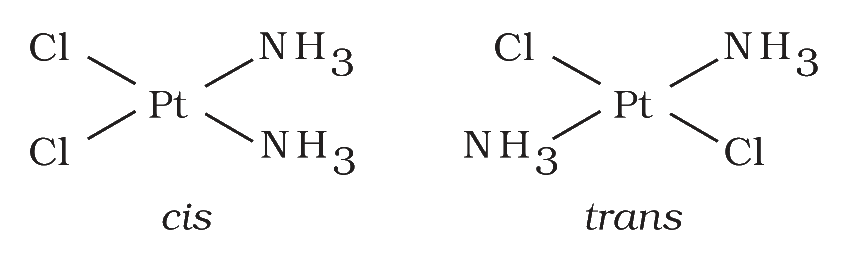
The figure shows the cis and trans isomers of the square planar complex \( \ce{[Pt(NH3)2Cl2]} \).
In each isomer, which ligand lies trans to a Cl ligand?
Answer & explanation
Correct answer: option 1
The correct answer is Option (1) → cis isomer: NH3; trans isomer: Cl
In a square planar complex, two ligands are cis when they are adjacent (on neighbouring corners of the square) and trans when they are opposite each other (on corners across the metal atom).
cis isomer — the two Cl ligands are on neighbouring corners, both on the left. Across Pt from each Cl lies an NH3 ligand, so the ligand trans to Cl is NH3.
trans isomer — the two Cl ligands are on opposite corners, so the ligand trans to one Cl is the other Cl.
Why the other options are incorrect
Option (2) cis isomer: Cl; trans isomer: NH3 — Incorrect. Both parts are reversed. In the cis isomer the two Cl ligands are adjacent, not opposite, and in the trans isomer the NH3 ligands are adjacent to each Cl.
Option (3) cis isomer: NH3; trans isomer: NH3 — Incorrect. The cis part is right, but in the trans isomer both NH3 ligands are on corners next to each Cl; the corner opposite a Cl holds the other Cl.
Option (4) cis isomer: Cl; trans isomer: Cl — Incorrect. The trans part is right, but in the cis isomer the second Cl is on the neighbouring corner, so it is cis, not trans, to the first Cl.
NCERT (2026-27 edition):
5.4.1 Geometric Isomerism – “This type of isomerism arises in heteroleptic complexes due to different possible geometric arrangements of the ligands. Important examples of this behaviour are found with coordination numbers 4 and 6. In a square planar complex of formula [MX2L2] (X and L are unidentate), the two ligands X may be arranged adjacent to each other in a cis isomer, or opposite to each other in a trans isomer as depicted in Fig. 5.2.”
Fig. 5.2: Geometrical isomers (cis and trans) of [Pt(NH3)2Cl2]