Arrange the following steps in ascending order in respect to determination of equilibrium level of income in an economy as a result of change in autonomous expenditure:
A. The output and aggregate demand will increase.
B. In the economy autonomous investment increased by Rs. 10 Cr.
C. The aggregate demand curve shifts in parallel upwards.
D. The investment multiplier works in forward direction.
Choose the correct answer from the options given below:
Answer & explanation
Correct answer: option 1
The correct answer is Option (1) → B, D, C, A
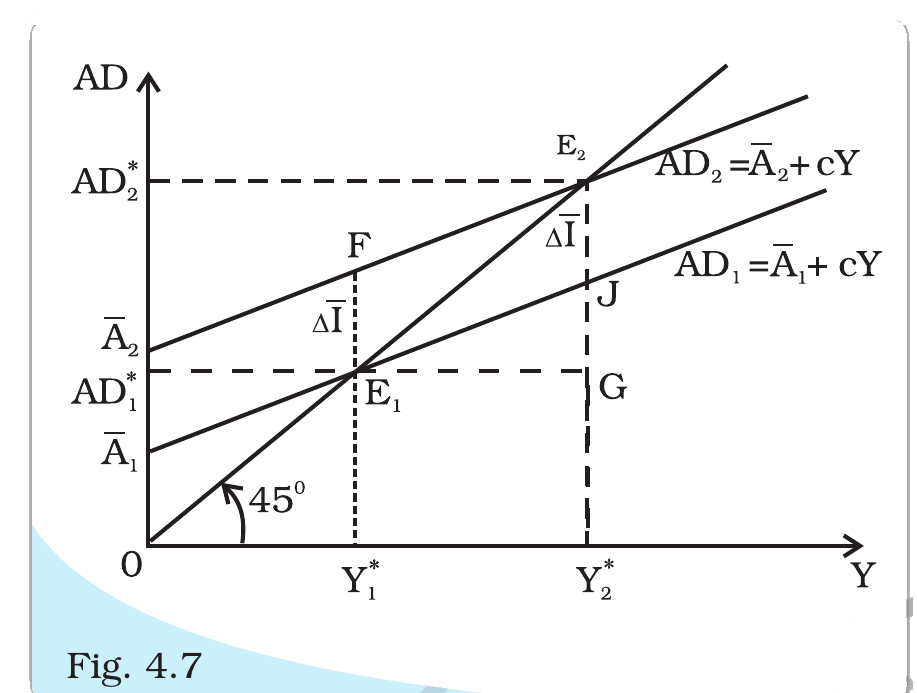
In the fixed price model, income settles where aggregate demand equals output. When autonomous spending rises, demand runs ahead of output, firms produce more, the extra income is spent again, and the economy moves round by round to a higher equilibrium level of income. The four statements are the steps of this movement.
B. In the economy autonomous investment increased by Rs. 10 Cr. — the first step, and the cause of all that follows. Autonomous investment does not depend on income; it changes with things such as the rate of interest and the availability of credit.
D. The investment multiplier works in forward direction. — the extra spending of Rs. 10 crore calls forth extra output, which is paid out as wages, interest, rent and profit, so income rises by Rs. 10 crore. People spend the fraction c (the MPC) of this extra income, so demand rises again by c × 10, firms raise output once more, and the process goes on round after round in smaller and smaller amounts. This is the multiplier mechanism.
C. The aggregate demand curve shifts in parallel upwards. — aggregate demand is AD = A + cY, so a rise in the autonomous part A raises the intercept by the amount of the extra investment and leaves the slope c unchanged. The AD line therefore shifts upward in parallel. At the old level of output, aggregate demand now exceeds output, and firms produce more to meet it.
The shift of the AD line and the working of the multiplier take place together, once autonomous investment rises, so D and C can be placed in either order.
A. The output and aggregate demand will increase. — the result. In the new equilibrium, output and aggregate demand have risen by more than the initial Rs. 10 crore: the total rise is the investment multiplier, 1/(1 − c), times the increase in investment.
That is why Option (1), which starts with the cause, B, and ends with the result, A, is the most appropriate answer. Option (2) puts the result, A, before the multiplier, D, that brings it about; Option (3) puts it even before the shift of the AD line; and Option (4) begins with C, before the rise in investment that sets it off.
Note: A same/similar question was asked in CUET (UG) in the papers below.
| 2026 | 2025 | 2024 | 2023 | 2022 |
| 21-05 S1* 23-05 S1 | – | – | – | – |
* A similar question.
NCERT (2025-26): “4.3.2 Effect of an Autonomous Change in Aggregate Demand on Income and Output … Now, let investment rise to 20. It can be seen that the new equilibrium will be 300. This can be seen by looking at the graph. This increase in income is due to rise in investment, which is a component of autonomous expenditure here. When autonomous investment increases, the AD1 line shifts in parallel upwards and assumes the position AD2.… 4.3.3 The Multiplier Mechanism It was seen in the previous section that with a change in the autonomous expenditure of 10 units, the change in equilibrium income is equal to 50 units (from 250 to 300). We can understand this by looking at the multiplier mechanism, which is explained below:… …When income increases by 10, consumption expenditure goes up by (0.8)10, since people spend 0.8 (= mpc) fraction of their additional income on consumption. Hence, in the next round, aggregate demand in the economy goes up by (0.8)10 and there again emerges an excess demand equal to (0.8)10. Therefore, in the next production cycle, producers increase their planned output further by (0.8)10 to restore equilibrium.…”
|