
CUETMOCK
  • Pricing
  • Mentors
Log inStart freeStart free mocks→

First test, then trust

Try a free CUET mock test.

Join 5,00,000+ students who rehearsed exam day on the exact NTA screen before sitting CUET. On the web and on Android.

Start free mocks →Get the Android app
CUETMOCK

India's #1 CUET Mock Test Platform. Original NCERT-based questions on the exact NTA exam screen — trusted by 5,00,000+ students since CUET 2022.

Get it onGoogle PlayScan to download the CUETMOCK app

Mock tests

  • CUET mock test series
  • Commerce mocks
  • Humanities (Arts) mocks
  • Science mocks
  • Languages & GAT mocks
  • Free practice questions
  • Pricing

Resources

  • CUET exam guide
  • CUET syllabus
  • Universities accepting CUET
  • Expert blogs
  • News & notifications
  • Webinars & counselling
  • CUET score calculator
  • How we estimate your rank
  • FAQs

Company

  • About us
  • Our leadership & team
  • Our toppers
  • Mentors
  • For schools
  • Contact us
  • Terms
  • Privacy
  • Refund policy

Talk to us

+91 7696 6630 56info@cuetmock.comWhatsApp us

Our other platforms

  • JEE Mock — For IIT-JEE aspirants
  • NEET Mock — For NEET aspirants

Newsletter

Exam updates, study material and offers — no spam.

© 2026 NYC Ventures Pvt. Ltd.

701-702, Royal Business Park, Zirakpur, Punjab - 140603

  • Terms of use
  • Privacy policy
  • Refund policy
  • Contact us

iCUETMOCK is an independent preparation platform, not affiliated with the National Testing Agency (NTA). Always check exam details on the official NTA website.

  • Home
  • Mock tests
  • CUET guide
  • Pricing
  • Log in
Home/Practice questions/Biology
BiologyBiotechnology and its Applications

Assertion (A): The production of synthetic human insulin through reco…

Assertion (A): The production of synthetic human insulin through recombinant DNA technology has provided a safer source of insulin for diabetes management.

Reason (R): During the maturation process into insulin, the C-peptide is removed, and it is not present in the mature insulin.

In light of the above statements, choose the most appropriate answer from the options given below:

Answer & explanation+

Correct answer: option 2

The correct answer is Option (2) → Both A and R are true, but R is not the correct explanation of A.

Assertion (A): The production of synthetic human insulin through recombinant DNA technology has provided a safer source of insulin for diabetes management. — True. Insulin for diabetes was earlier taken from the pancreas of slaughtered cattle and pigs. This animal insulin caused allergy or other reactions to the foreign protein in some patients. Human insulin made by recombinant DNA technology (in E. coli, by Eli Lilly in 1983) avoids this, so it is a safer source.

Reason (R): During the maturation process into insulin, the C-peptide is removed, and it is not present in the mature insulin. — True. In humans, insulin is made as a pro-hormone (pro-insulin) with an extra stretch called the C peptide. The C peptide is removed during maturation, so mature insulin has only chains A and B joined by disulphide bridges.

Why R does not explain A? A is about the source of insulin: rDNA human insulin is safer because it is not a foreign animal protein. R is about how natural insulin matures in the body by losing its C peptide. The removal of the C peptide happens in all insulin and is not what makes rDNA insulin safer; in fact, the rDNA method made chains A and B separately and joined them. So both statements are correct, but R is not the explanation of A.

NCERT Extract:
Genetically Engineered Insulin – “… Insulin used for diabetes was earlier extracted from pancreas of slaughtered cattle and pigs. Insulin from an animal source, though caused some patients to develop allergy or other types of reactions to the foreign protein. Insulin consists of two short polypeptide chains: chain A and chain B, that are linked together by disulphide bridges (Figure 10.3).”
Genetically Engineered Insulin – “In mammals, including humans, insulin is synthesised as a pro-hormone (like a pro-enzyme, the pro-hormone also needs to be processed before it becomes a fully mature and functional hormone) which contains an extra stretch called the C peptide. This C peptide is not present in the mature insulin and is removed during maturation into insulin.”
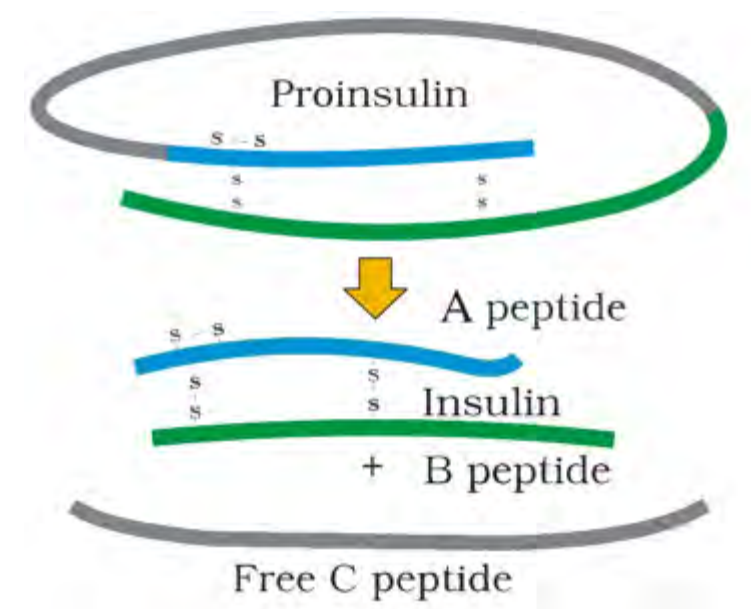
Textbook figure

Figure 10.3 Maturation of pro-insulin into insulin (simplified)

Advertisement

Practise more on Biotechnology and its Applications

Chapter-wise mocks on the real NTA exam screen, with solutions and your rank. Your first mocks are free.

Start free mocks →

Advertisement

Next questions

  1. The 'middle India' band holds most of India's tribal population. All of the following describe its extent EXCEPT:Sociology · Indian Society: Continuity and Change
  2. Given below are two statements: one is labelled as Assertion (A) and the other is labelled as Reason (R).Assertion (A): Among the two nucle…Biology · Molecular Basis of Inheritance
  3. Which part of the plant is typically free of viruses and can be used to grow virus-free plants?Biology · Biotechnology and its Applications
  4. नीचे दो कथन दिए गए हैं:कथन I: उपसर्ग वे शब्दांश हैं जो किसी शब्द से पहले जुड़कर नया शब्द बनाते हैं, जैसे 'हार' से 'उपहार'।कथन II: 'आहार' और…Hindi · उपसर्ग
  5. Choose the correct word to complete the sentence:On the long train journey to Howrah, the cousins played rummy with a new ________ of cards.English · Collective Noun
  6. Which inverse trigonometric function does following graph represent?Maths. Section B1 · Inverse Trigonometric Functions
  7. निम्नलिखित में से शुद्ध वाक्य चुनिए -Hindi · वाक्य शुद्धि
  8. How many days are there in y weeks and y days?General Aptitude Test · Verbal Reasoning
  9. A historian traces how zamindaris were built up through slow processes of consolidation in Mughal India. Which of the following statements…History · Medieval India: Peasants, Zamindars and the State
  10. Given below are two statements: one is labelled as Assertion (A) and the other is labelled as Reason (R).Assertion (A): The 'Sixth Extincti…Biology · Biodiversity and Conservation