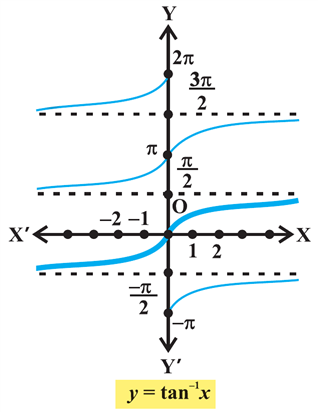
Which inverse trigonometric function does following graph represent?
Answer & explanation
Correct answer: option 3
The correct answer is Option (3) → \(\tan^{-1}x\)
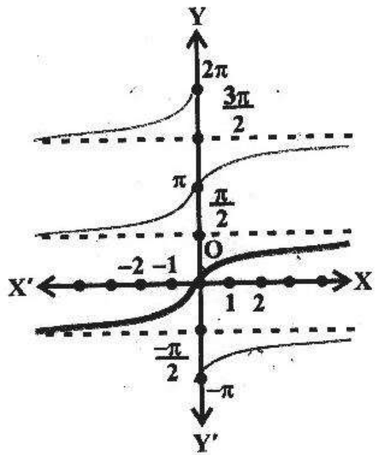
The bold curve is defined for every real x, passes through the origin and rises from left to right. It approaches \(y=\frac{\pi}{2}\) as \(x\to\infty\) and \(y=-\frac{\pi}{2}\) as \(x\to-\infty\).
These are exactly the features of the principal value branch of \(\tan^{-1}x\): domain R, range \(\left(-\frac{\pi}{2}, \frac{\pi}{2}\right)\), increasing, with \(\tan^{-1}0=0\). The other curves are the branches of \(\tan^{-1}x\) with ranges shifted by multiples of π, separated by the dashed lines \(y=\pm\frac{\pi}{2}, \frac{3\pi}{2}\).
Why the other options are incorrect
Option (1) \(\sec^{-1}x\) — Incorrect. \(\sec^{-1}x\) is not defined for −1 < x < 1, but the graph passes through the origin.
Option (2) \(\mathrm{cosec}^{-1}x\) — Incorrect. \(\mathrm{cosec}^{-1}x\) is also not defined for −1 < x < 1.
Option (4) \(\cot^{-1}x\) — Incorrect. Its principal branch is decreasing with range (0, π), and \(\cot^{-1}0=\frac{\pi}{2}\), not 0.
NCERT (2026-27 edition):
Basic Concepts