
Which of the following flowers is used to understand incomplete dominance?
Answer & explanation
Correct answer: option 2
The correct answer is Option (2) → Flowers of snapdragon
In incomplete dominance the F1 does not look like either parent but is in between the two. NCERT uses flower colour in the dog flower, snapdragon (Antirrhinum sp.): a cross of red (RR) and white (rr) plants gives pink (Rr) F1 plants.
Option (1) Flowers of sweet pea — Incorrect. Sweet pea is not the example used in NCERT for incomplete dominance, and no in-between flower colour is described for it in the book.
Option (2) Flowers of snapdragon — Correct. In snapdragon, R is not completely dominant over r, so the heterozygote Rr is pink, in between red and white.
Option (3) Flowers of garden pea — Incorrect. Garden pea was Mendel’s plant. In its flower colour violet is fully dominant over white, so the F1 is violet, like one parent. That is complete dominance.
NCERT Extract:
Incomplete Dominance – “When experiments on peas were repeated using other traits in other plants, it was found that sometimes the F1 had a phenotype that did not resemble either of the two parents and was in between the two. The inheritance of flower colour in the dog flower (snapdragon or Antirrhinum sp.) is a good example to understand incomplete dominance. In a cross between true-breeding red-flowered (RR) and true-breeding white-flowered plants (rr), the F1 (Rr) was pink (Figure 4.6).”
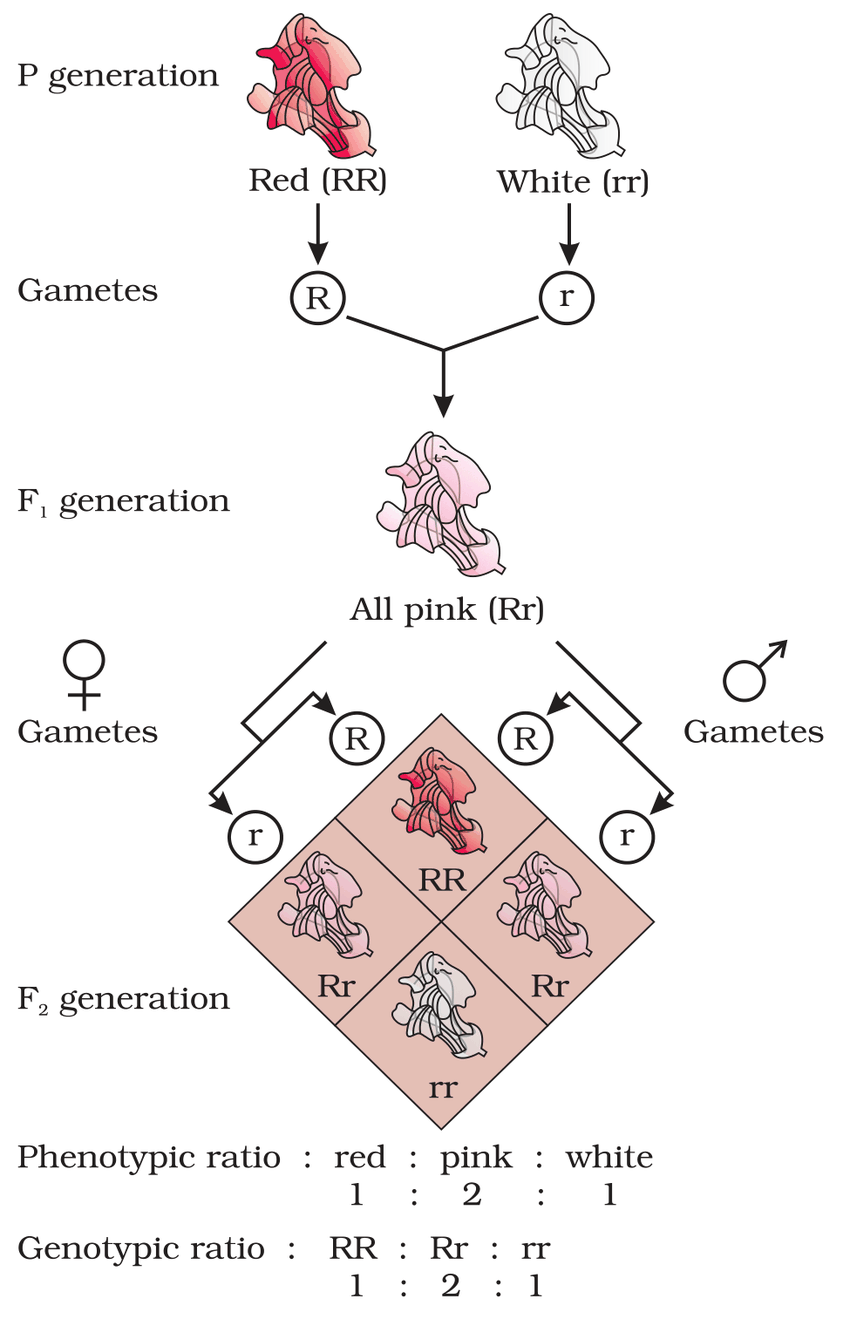
Figure 4.6 Results of monohybrid cross in the plant Snapdragon, where one allele is incompletely dominant over the other allele