
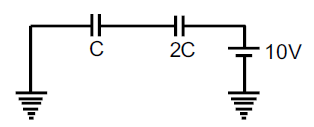
In the circuit shown in the figure, \( C=6\,\mu\mathrm{F} \). The charge stored in the capacitor of capacitance C is
Answer & explanation
Correct answer: option 3
The correct answer is Option (3) → \( 40\,\mu\mathrm{C} \)
Capacitors in series carry the same charge, and the reciprocals of their capacitances add to give the reciprocal of the equivalent capacitance.
From the figure, the free end of C and the negative terminal of the 10 V cell are both earthed. So C and 2C are in series across the 10 V cell.
\( C=6\,\mu\mathrm{F} \)
\( 2C=12\,\mu\mathrm{F} \)
The equivalent capacitance is:
\( \begin{aligned} \frac{1}{C_{\mathrm{eq}}} &= \frac{1}{6\,\mu\mathrm{F}}+\frac{1}{12\,\mu\mathrm{F}} \\ &= \frac{2+1}{12\,\mu\mathrm{F}} \\ &= \frac{1}{4\,\mu\mathrm{F}} \end{aligned} \)
\( C_{\mathrm{eq}}=4\,\mu\mathrm{F} \)
The charge drawn from the cell is:
\( \begin{aligned} Q &= C_{\mathrm{eq}}V \\ &= 4\,\mu\mathrm{F}\times10\,\mathrm{V} \\ &= 40\,\mu\mathrm{C} \end{aligned} \)
Each capacitor in the series carries this charge. Therefore, the charge stored in C is \( 40\,\mu\mathrm{C} \).