
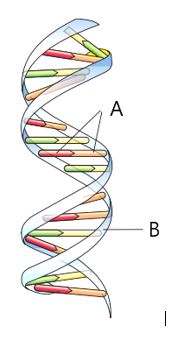
Observe the given picture and identify (A) and (B).
Answer & explanation
Correct answer: option 2
The correct answer is Option (2) → (A) Base pairs (B) Sugar phosphate backbone
The figure shows a DNA double helix. The two twisted ribbons on the outside are the two polynucleotide chains, and the coloured rungs between them are the bases paired across the strands. In DNA, the backbone is made of sugar and phosphate and the bases project inside, where adenine pairs with thymine and guanine with cytosine.
Option (1) (A) Sugar phosphate backbone (B) Base pairs — Incorrect. This reverses the labels. A points to the rungs inside the helix, which are base pairs, and B points to the outer ribbon, which is the backbone.
Option (2) (A) Base pairs (B) Sugar phosphate backbone — Correct. A marks the base pairs held between the two strands, and B marks the sugar-phosphate backbone on the outside of the helix.
Option (3) (A) Sugar (B) Base pairs — Incorrect. Sugar is part of the backbone on the outside, not the rungs marked A. B is also the outer ribbon, not a base pair.
Option (4) (A) Phosphate (B) Base pairs — Incorrect. Phosphate, like sugar, is part of the outer backbone. Neither A nor B is labelled correctly here.
NCERT Extract:
Structure of Polynucleotide Chain – “… The salient features of the Double-helix structure of DNA are as follows: (i) It is made of two polynucleotide chains, where the backbone is constituted by sugar-phosphate, and the bases project inside. (ii) The two chains have anti-parallel polarity. It means, if one chain has the polarity 5′ → 3′, the other has 3′ → 5′. (iii) The bases in two strands are paired through hydrogen bond (H-bonds) forming base pairs (bp).”