
CUETMOCK
  • Pricing
  • Mentors
Log inStart freeStart free mocks→

First test, then trust

Try a free CUET mock test.

Join 5,00,000+ students who rehearsed exam day on the exact NTA screen before sitting CUET. On the web and on Android.

Start free mocks →Get the Android app
CUETMOCK

India's #1 CUET Mock Test Platform. Original NCERT-based questions on the exact NTA exam screen — trusted by 5,00,000+ students since CUET 2022.

Get it onGoogle PlayScan to download the CUETMOCK app

Mock tests

  • CUET mock test series
  • Commerce mocks
  • Humanities (Arts) mocks
  • Science mocks
  • Languages & GAT mocks
  • Free practice questions
  • Pricing

Resources

  • CUET exam guide
  • CUET syllabus
  • Universities accepting CUET
  • Expert blogs
  • News & notifications
  • Webinars & counselling
  • CUET score calculator
  • How we estimate your rank
  • FAQs

Company

  • About us
  • Our leadership & team
  • Our toppers
  • Mentors
  • For schools
  • Contact us
  • Terms
  • Privacy
  • Refund policy

Talk to us

+91 7696 6630 56info@cuetmock.comWhatsApp us

Our other platforms

  • JEE Mock — For IIT-JEE aspirants
  • NEET Mock — For NEET aspirants

Newsletter

Exam updates, study material and offers — no spam.

© 2026 NYC Ventures Pvt. Ltd.

701-702, Royal Business Park, Zirakpur, Punjab - 140603

  • Terms of use
  • Privacy policy
  • Refund policy
  • Contact us

iCUETMOCK is an independent preparation platform, not affiliated with the National Testing Agency (NTA). Always check exam details on the official NTA website.

  • Home
  • Mock tests
  • CUET guide
  • Pricing
  • Log in
Home/Practice questions/Chemistry
ChemistryInorganic: D and F Block Elements

Arrange the following metals in decreasing order of their melting poi…

Arrange the following metals in decreasing order of their melting points:

(A) Molybdenum

(B) Copper

(C) Tungsten

(D) Manganese

Choose the correct answer from the options given below:

Answer & explanation+

Correct answer: option 4

The correct answer is Option (4) → (C), (A), (D), (B)

Transition metals have high melting points because of strong metallic bonding, in which the (n−1)d electrons take part along with the ns electrons. The melting points follow two trends:

  • Across a series: the melting point rises to a maximum near the middle (d5), where the number of unpaired d electrons is greatest, and then falls. Manganese is an exception with an unusually low melting point, and copper (d10) at the end of the series is low.

  • Down a group: the 4d and 5d metals have much higher melting points than the 3d metals, because their larger d orbitals form stronger metallic bonds.

So the melting points decrease as:

    5d (group 6) > 4d (group 6) > 3d (group 7) > 3d (group 11)
    W > Mo > Mn > Cu

Matching the given metals:

  • (C) Tungsten: 5d, m.p. about 3680 K (highest of all metals)

  • (A) Molybdenum: 4d, m.p. about 2890 K

  • (D) Manganese: 3d, m.p. about 1520 K

  • (B) Copper: 3d, filled d subshell, m.p. about 1360 K

NCERT (2026-27 edition):
Physical Properties – …
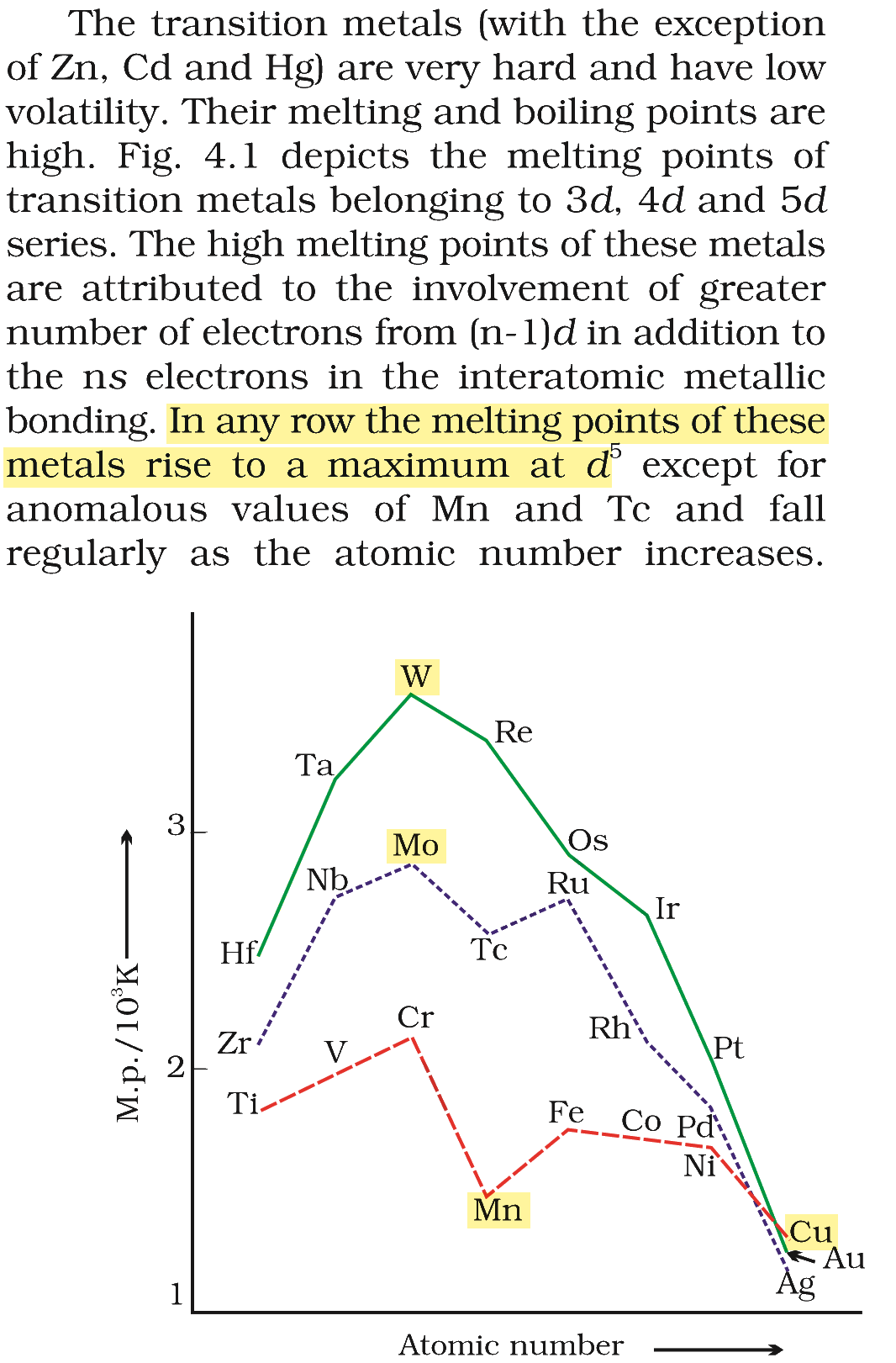
Textbook extract

Advertisement

Practise more on Inorganic: D and F Block Elements

Chapter-wise mocks on the real NTA exam screen, with solutions and your rank. Your first mocks are free.

Start free mocks →

Advertisement

Next questions

  1. The Santosh Trophy is the national championship of India in which sport?General Aptitude Test · General Knowledge
  2. A monochromatic light of frequency 5.0×10^14 Hz is emitted by a source of power 1.98×10^-3 W. The number of photons per second, on average,…Physics · Dual Nature of Radiation and Matter
  3. If the system of equation λ x+3y-z=4 x+2y+z=20 -λ x+y+2z=-5 does not possess a unique solution, thenMaths. Section B1 · Determinants
  4. Arrange the following steps in correct order to derive Snell's law using the Huygens principle:(A) Construct secondary wavelets in both med…Physics · Wave Optics
  5. The average weight of 4 men increases by 3 kg when one of them, who weighs 120 kg, is replaced by another man. What is the weight of the ne…General Aptitude Test · Numerical Ability
  6. गद्यांश के अनुसार वनस्पति-विज्ञान में बाँस को किस कुल का पौधा माना जाता है?Hindi · अपठित गद्यांश (Comprehension - Prose)
  7. What type of dominance is illustrated by the ABO blood group system?Biology · Principles of Inheritance and Variation
  8. Match List-I with List-II.List-I(Substance electrolysed)List-II(Product at the cathode; product at the anode)(A) Molten sodium chloride(I)…Chemistry · Physical: Electro Chemistry
  9. Which of the following words is different from the other three?English · Odd One Out
  10. When acetone is added to ethanol, what type of deviation from Raoult’s law does the solution show?Chemistry · Physical: Solutions