Arrange the following steps in correct order to derive Snell's law using the Huygens principle:
(A) Construct secondary wavelets in both media using different speeds (V1 and V2) of light.
(B) Identify the refracted wave front as the tangent plane to the secondary wavelets in the second medium.
(C) Show the relationship between the angles and velocities to obtain Snell's law.
(D) Consider the incident wave front approaching the interface separating the two media.
Choose the correct answer from the options given below:
Answer & explanation
Correct answer: option 1
The correct answer is Option (1) → (D), (A), (B), (C)
Huygens’ principle: every point on a wavefront is a source of secondary wavelets, and the new wavefront is the common tangent to these wavelets.
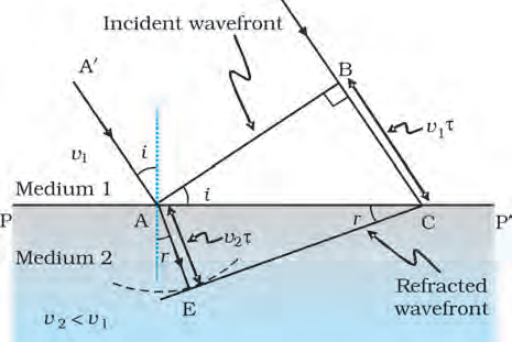
(D) Consider the incident wave front approaching the interface separating the two media. — Start with the plane wavefront AB meeting the interface at angle of incidence i.
(A) Construct secondary wavelets in both media using different speeds (V1 and V2) of light. — In the time \( \tau \) that the other end B takes to reach the surface at C, travelling \( v_1\tau \) in the first medium, the wavelet from A spreads to a radius \( v_2\tau \) in the second medium.
(B) Identify the refracted wave front as the tangent plane to the secondary wavelets in the second medium. — The refracted wavefront CE is the tangent plane from C to this wavelet, at angle of refraction r.
(C) Show the relationship between the angles and velocities to obtain Snell's law. — From the two right-angled triangles with common hypotenuse AC, \( \sin i = v_1\tau/AC \) and \( \sin r = v_2\tau/AC \), which give Snell’s law:
\( \displaystyle \frac{\sin i}{\sin r} = \frac{v_1}{v_2} = n_{21} \)
So the correct order is (D), (A), (B), (C).
NCERT (2026-27):
Refraction of a Plane Wave – “… We assume a plane wavefront AB propagating in the direction A′A incident on the interface at an angle \( i \) as shown in the figure. … In order to determine the shape of the refracted wavefront, we draw a sphere of radius \( v_2\tau \) from the point A in the second medium (the speed of the wave in the second medium is \( v_2 \)). Let CE represent a tangent plane drawn from the point C on to the sphere. Then, \( \mathrm{AE} = v_2\,\tau \) and CE would represent the refracted wavefront. … Thus we obtain
\( \displaystyle \frac{\sin i}{\sin r} = \frac{v_1}{v_2} \qquad (10.3) \)”