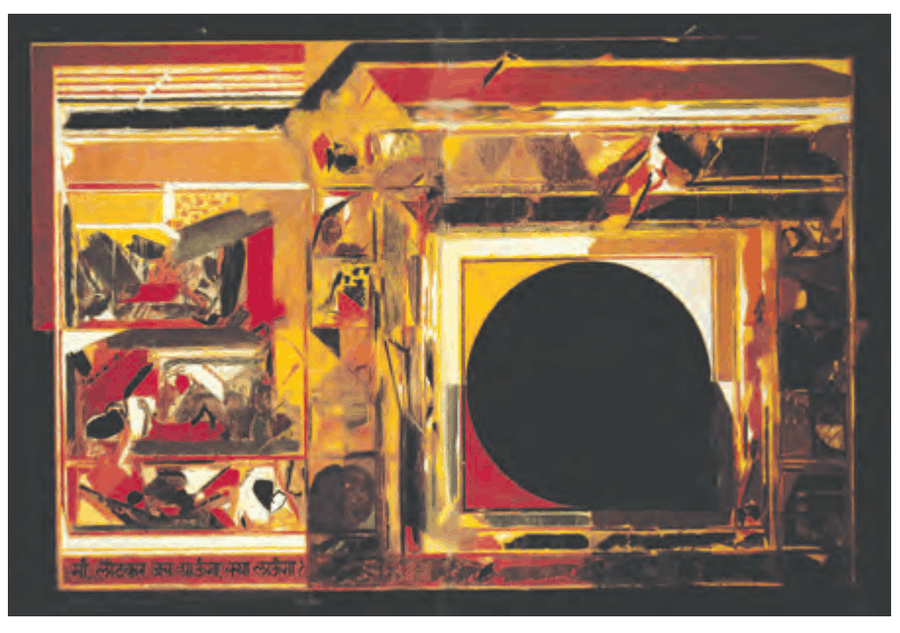
Modern Indian art includes prints, paintings and murals by many artists. Match the artists in List-I with their works in List-II.
| List-I | List-II |
|---|---|
| A. Chittoprasad | I. The Lives of Medieval Saints |
| B. Amrita Sher-Gil | II. Ma |
| C. Benode Behari Mukherjee | III. Hungry Bengal |
| D. S. H. Raza | IV. Haldi Grinder |
Choose the correct answer from the options given below:
Answer & explanation
Correct answer: option 1
The correct answer is Option (1) → A-III, B-IV, C-I, D-II
| List-I | List-II | Reason |
|---|---|---|
| (A) Chittoprasad | (III) Hungry Bengal | His sketches from the famine villages were published as pamphlets under this name. |
| (B) Amrita Sher-Gil | (IV) Haldi Grinder | She painted women grinding dry turmeric, in bright, saturated pigments. |
| (C) Benode Behari Mukherjee | (I) The Lives of Medieval Saints | His mural in Hindi Bhavana, Shantiniketan, recalls Bhakti poets like Kabir and Tulsidas. |
| (D) S. H. Raza | (II) Ma | The work is printed under his name; Raza moved towards abstraction. |
Note: This topic was not named in the CUET 2026 syllabus, but it was part of the NCERT chapter. In 2025 and 2026, NTA also asked questions on topics in NCERT that the CUET syllabus did not name. So our mocks have questions from every part of the NCERT chapter, to give you enough practice. Read the whole chapter, not only the sub-topics named in the syllabus.
NCERT (2026-27): “Modern Ideologies and Political Art in India …Chittoprasad’s etchings, linocuts and lithographs showed the deplorable condition of the poor. It is not surprising that he was asked by the Communist Party of India to travel to villages worst affected by the Bengal Famine and make sketches. These were later published as pamphlets under the name, Hungry Bengal, much to the annoyance of the British.” “Haldi Grinder Amrita Sher-Gil painted Haldi Grinder in 1940. This was the time when she was seeking inspiration from India’s idyllic rural scene. Such a scene, depicting Indian women busy in a traditional activity of grinding dry turmeric, had to be painted in Indian style. It is not surprising that she used bright, saturated pigments to paint this work.” “The Lives of Medieval Saints The Lives of Medieval Saints, a mural in Hindi Bhavana, Shantiniketan, was created by Benode Behari Mukherjee around the eve of India’s Independence from Colonial rule, during 1946–1947.”
S. H. Raza, Ma, 1972. Bombay, India |