
CUETMOCK
  • Pricing
  • Mentors
Log inStart freeStart free mocks→

First test, then trust

Try a free CUET mock test.

Join 5,00,000+ students who rehearsed exam day on the exact NTA screen before sitting CUET. On the web and on Android.

Start free mocks →Get the Android app
CUETMOCK

India's #1 CUET Mock Test Platform. Original NCERT-based questions on the exact NTA exam screen — trusted by 5,00,000+ students since CUET 2022.

Get it onGoogle PlayScan to download the CUETMOCK app

Mock tests

  • CUET mock test series
  • Commerce mocks
  • Humanities (Arts) mocks
  • Science mocks
  • Languages & GAT mocks
  • Free practice questions
  • Pricing

Resources

  • CUET exam guide
  • CUET syllabus
  • Universities accepting CUET
  • Expert blogs
  • News & notifications
  • Webinars & counselling
  • CUET score calculator
  • How we estimate your rank
  • FAQs

Company

  • About us
  • Our leadership & team
  • Our toppers
  • Mentors
  • For schools
  • Contact us
  • Terms
  • Privacy
  • Refund policy

Talk to us

+91 7696 6630 56info@cuetmock.comWhatsApp us

Our other platforms

  • JEE Mock — For IIT-JEE aspirants
  • NEET Mock — For NEET aspirants

Newsletter

Exam updates, study material and offers — no spam.

© 2026 NYC Ventures Pvt. Ltd.

701-702, Royal Business Park, Zirakpur, Punjab - 140603

  • Terms of use
  • Privacy policy
  • Refund policy
  • Contact us

iCUETMOCK is an independent preparation platform, not affiliated with the National Testing Agency (NTA). Always check exam details on the official NTA website.

  • Home
  • Mock tests
  • CUET guide
  • Pricing
  • Log in
Home/Practice questions/Chemistry
ChemistryPhysical: Chemical Kinetics

The order of a reaction

Rate law

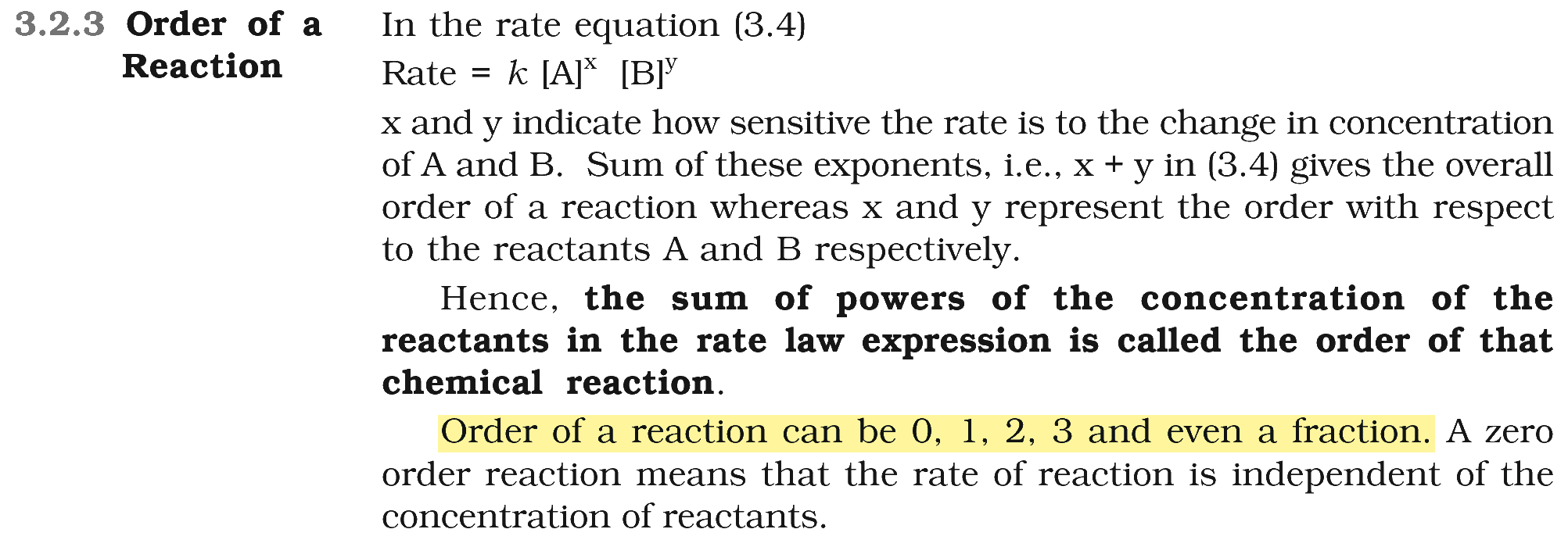
Rate law is the expression in which reaction rate is given in terms of molar concentration of reactants, with each term raised to some power, which may or may not be same as the stoichiometric coefficient of the reacting species in a balanced chemical equation. The sum of powers of the concentration of the reactants, in the rate law expression is called the order of that chemical reaction. The number of reacting species (atoms, ions, or molecules) taking part in an elementary reaction, which must collide simultaneously in order to bring about a chemical reaction, is called molecularity of a reaction.

The order of a reaction

Answer & explanation+

Correct answer: option 2

The correct answer is Option (2) → can be fractional

The order of a reaction is the sum of the powers of the concentration terms in the experimentally determined rate law. For a reaction with rate law

    \( \displaystyle \text{Rate}=k[A]^{x}[B]^{y} \)

the order is x + y. Since x and y are found by experiment, they need not be whole numbers: the order can be zero, a whole number or a fraction. For example, the decomposition of ethanal has a rate law with a power of 3/2:

    \( \displaystyle \ce{CH3CHO -> CH4 + CO} \)

    \( \displaystyle \text{Rate}=k[\ce{CH3CHO}]^{3/2} \)

    \( \displaystyle \text{Order}=\frac{3}{2}=1.5 \)

Why the other options are incorrect

  • Option (1) varies with temperature — Incorrect. Temperature changes the rate constant k (Arrhenius equation), not the powers in the rate law.

  • Option (3) depends on stoichiometric coefficients of reactants — Incorrect. The order is found by experiment and often differs from the coefficients; for example, \( \ce{2N2O5} \) → \( \ce{4NO2} \) + \( \ce{O2} \) has Rate = k[N2O5], which is first order. Only for elementary reactions do the two agree.

  • Option (4) depends on time used to carry out reaction — Incorrect. The order is a fixed feature of the rate law; it does not change as the reaction proceeds.

NCERT (2026-27 edition):
Order of a Reaction
Textbook extract

Advertisement

Practise more on Physical: Chemical Kinetics

Chapter-wise mocks on the real NTA exam screen, with solutions and your rank. Your first mocks are free.

Start free mocks →

Advertisement

Next questions

  1. Match List-I with List-IILIST-ILIST-IIExamplesContraceptive methods(A) Diaphragms(I) Surgical method(B) Coitus interruptus(II) Barrier meth…Biology · Reproductive Health
  2. Why do rainbow lizards follow an intermittent basking routine during the day?English · Comprehension - (Narrative / Factual)
  3. Rate of change of area of a circle with respect to radius(A) When r = 2 cm is 4 π cm2/cm.(B) When r = 6 cm is 12 π cm2/cm.(C) When r = 12 c…Applied Maths. Section A · Applications of Derivatives (Section A)
  4. What is the criticism of Agenda 21?Political Science · Contemporary World Politics: Environment and Natural Resources
  5. If A=≤ft[a_ij]_3× 3 and a_ij=2i-j , thenMatch List-I with List-IIList-IList-II(A) a_21+a_32 (I) 0(B) |A| (II) 19(C) Number of the elements…Maths. Section B1 · Matrices
  6. Identify the correct sentence/s.(A) The water in this tank is too cold.(B) No one hardly goes to the temple daily(C) He performed badly in…English · Spot Error
  7. The corner points of the bounded feasible region determined by x+3y≤ 60,x+y≥ 10,x≤ y,x≥ 0,y≥ 0 are A(0, 10), B(5, 5), C(15, 15) and D(0, 20…Applied Maths. Section A · Linear Programming (Section A)
  8. Identify the region of ‘pillar inscription’ of Asoka placed at the centre of map of the Indian subcontinent?History · Ancient India: Kings, Farmers and Towns
  9. Which one of the following is not true?Accountancy Part B · Financial Statements of a Company
  10. What were the demands of the nationwide railway strike in 1974?Political Science · Politics in India Since Independence: Crisis of democratic Order