PCR
Read the following passage carefully and answer the given questions.
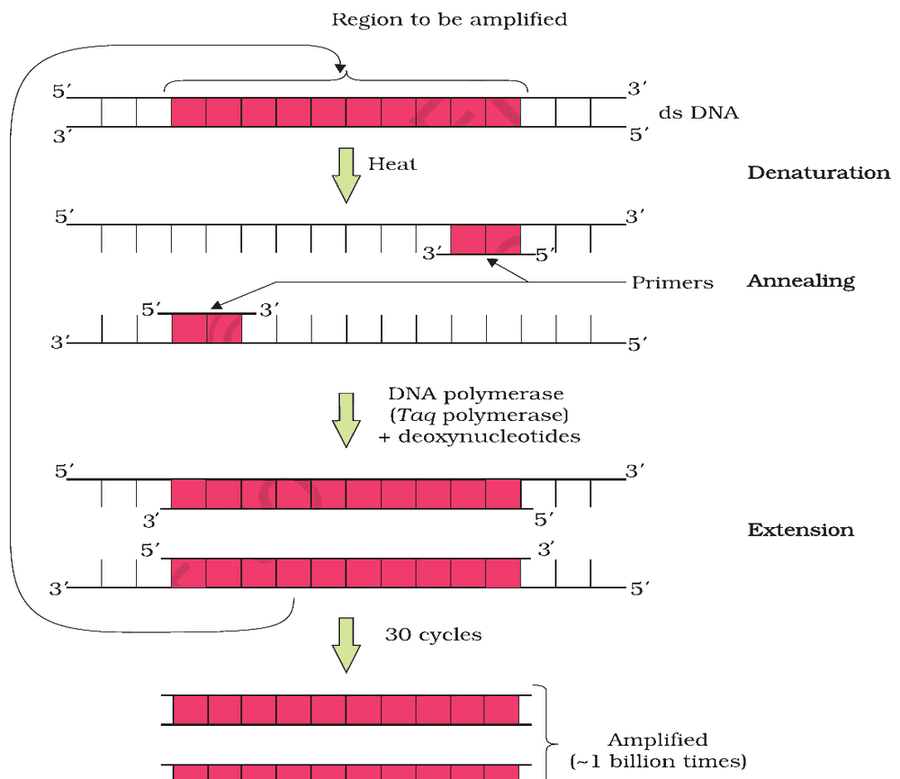
In PCR multiple copies of the gene of interest is synthesised in vitro using two sets of primers and the enzyme DNA polymerase. The enzyme extends the primers using the nucleotides provided in the reaction and the genomic DNA as template. If the process of replication of DNA is repeated many times, the segment of DNA can be amplified to approximately billion times, i.e., 1 billion copies are made. Such repeated amplification is achieved by the use of a thermostable DNA polymerase, which remain active during the high temperature induced denaturation of double stranded DNA. The amplified fragment if desired can now be used to ligate with a vector for further cloning.
Which one of the following steps is not involved in polymerase chain reaction?
Answer & explanation
Correct answer: option 4
The correct answer is Option (4) → Decomposition
The polymerase chain reaction (PCR) makes many copies of a piece of DNA. Each cycle has three steps: denaturation, primer annealing and extension of the primers.
(1) Extension — A step of PCR. The thermostable DNA polymerase adds nucleotides to the primers and makes the new strand.
(2) Annealing — A step of PCR. The primers attach to the matching regions of the single DNA strands.
(3) Denaturation — A step of PCR. A high temperature separates the double-stranded DNA into two single strands.
(4) Decomposition — Not a step of PCR. Decomposition is the breakdown of dead organic matter by microbes. PCR builds copies of DNA and does not break anything down.
Note: The passage is taken from NCERT. NTA has put lines of the NCERT text together to make it. Most CUET (UG) questions come straight from NCERT, so study the book line by line, including figures and their titles.
NCERT Extract:
Amplification of Gene of Interest Using PCR – “… PCR stands for Polymerase Chain Reaction. In this reaction, multiple copies of the gene (or DNA) of interest is synthesised in vitro using two sets of primers (small chemically synthesised oligonucleotides that are complementary to the regions of DNA) and the enzyme DNA polymerase. The enzyme extends the primers using the nucleotides provided in the reaction and the genomic DNA as template.”
Decomposition – “… Similarly, decomposers break down complex organic matter into inorganic substances like carbon dioxide, water and nutrients and the process is called decomposition.”