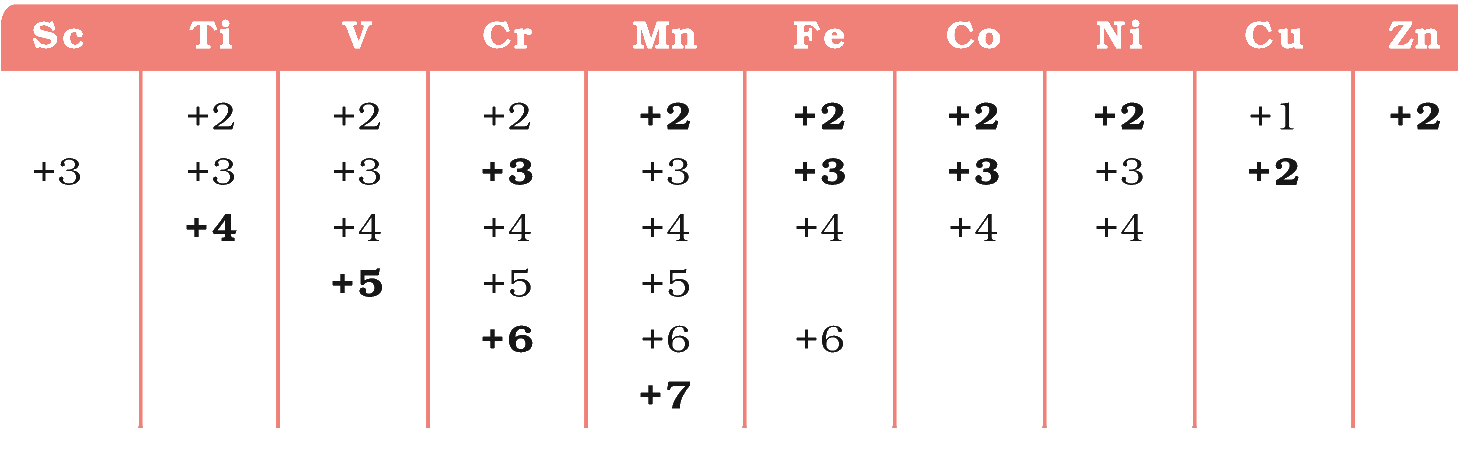
The transition metals show a variety of oxidation states. Select the metal(s) from the following which shows + 5 oxidation state.
A. Mn
B. Cu
C. Cr
D. Ti
Choose the correct answer from the options given below:
Answer & explanation
Correct answer: option 4
The correct answer is Option (4) → A and C only
Transition metals show variable oxidation states because both the (n−1)d and the ns electrons can take part in bonding. The highest oxidation state usually equals the total number of 4s and 3d electrons, and in the first half of the series every state from +2 up to this maximum is known. After the middle of the series (from iron onwards) the d electrons are paired, and fewer states are shown.
A. Mn — Correct. Mn (Z = 25) is [Ar]3d54s2, with 7 valence electrons, so it shows every state from +2 to +7, including +5 (e.g. \( \ce{MnO4^{3-}} \)).
B. Cu — Incorrect. Cu (Z = 29) is [Ar]3d104s1; its filled 3d subshell allows only +1 (losing 4s1) and +2 (3d9).
C. Cr — Correct. Cr (Z = 24) is [Ar]3d54s1, with 6 valence electrons, so it shows +2 to +6, including +5.
D. Ti — Incorrect. Ti (Z = 22) is [Ar]3d24s2, with only 4 valence electrons, so its highest state is +4.
NCERT (2026-27 edition):
Oxidation States – …