
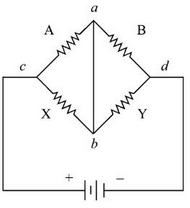
In a Wheatstone bridge shown, X = Y and \( A \gt B \). The direction of current between a & b will be:
Answer & explanation
Correct answer: option 2
The correct answer is Option (2) → From b to a
Current in the wire ab flows from the point at higher potential to the point at lower potential, so the potentials of a and b are compared.
From the figure, the + terminal is joined to c and the - terminal to d. Let \( V \) be the potential difference between c and d. In each branch the potential drop is shared in proportion to the resistances (potential divider).
\( \displaystyle V_c - V_a = \frac{A}{A+B}\,V \)
\( \displaystyle V_c - V_b = \frac{X}{X+Y}\,V = \frac{V}{2} \)
Since \( A \gt B \), the fraction \( A/(A+B) \) is more than \( 1/2 \), so the drop from c to a is larger than the drop from c to b. Point a is at a lower potential than b:
\( \displaystyle V_b \gt V_a \)
So the current flows from b to a in the wire joining them.