CUETMOCK
  • Pricing
  • Mentors
Log inStart freeStart free mocks→

First test, then trust

Try a free CUET mock test.

Join 5,00,000+ students who rehearsed exam day on the exact NTA screen before sitting CUET. On the web and on Android.

Start free mocks →Get the Android app
CUETMOCK

India's #1 CUET Mock Test Platform. Original NCERT-based questions on the exact NTA exam screen — trusted by 5,00,000+ students since CUET 2022.

Get it onGoogle PlayScan to download the CUETMOCK app

Mock tests

  • CUET mock test series
  • Browse all papers
  • Commerce mocks
  • Humanities (Arts) mocks
  • Science mocks
  • Languages & GAT mocks
  • Free practice questions
  • Pricing

Resources

  • CUET exam guide
  • CUET syllabus
  • Universities accepting CUET
  • Expert blogs
  • News & notifications
  • Webinars & counselling
  • CUET score calculator
  • How we estimate your rank
  • FAQs

Company

  • About us
  • Our leadership & team
  • Our toppers
  • Mentors
  • For schools
  • Contact us
  • Terms
  • Privacy
  • Refund policy

Talk to us

+91 7696 6630 56info@cuetmock.comWhatsApp us

Our other platforms

  • JEE Mock — For IIT-JEE aspirants
  • NEET Mock — For NEET aspirants

Newsletter

Exam updates, study material and offers — no spam.

© 2026 NYC Ventures Pvt. Ltd.

701-702, Royal Business Park, Zirakpur, Punjab - 140603

  • Terms of use
  • Privacy policy
  • Refund policy
  • Contact us

iCUETMOCK is an independent preparation platform, not affiliated with the National Testing Agency (NTA). Always check exam details on the official NTA website.

  • Home
  • Mock tests
  • CUET guide
  • Pricing
  • Log in
Home/Practice questions/Economics
EconomicsMicro Economics: Market Equilibrium

If supply curve shifts leftward and demand curve shifts rightward the…

If supply curve shifts leftward and demand curve shifts rightward then how it will affect the pricing?

Answer & explanation+

Correct answer: option 1

The correct answer is Option (1) → Increase the price.

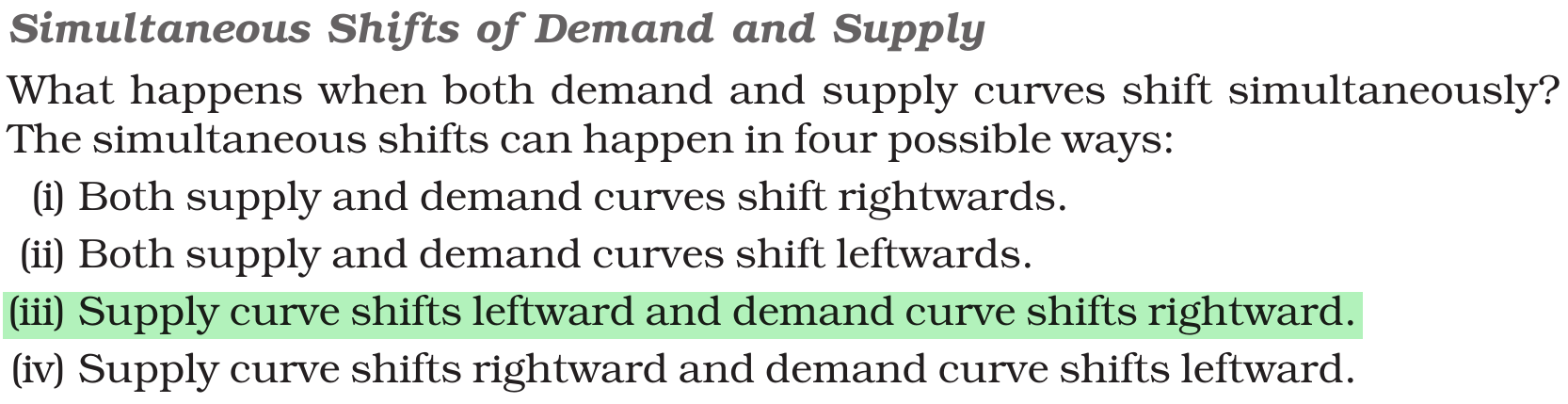
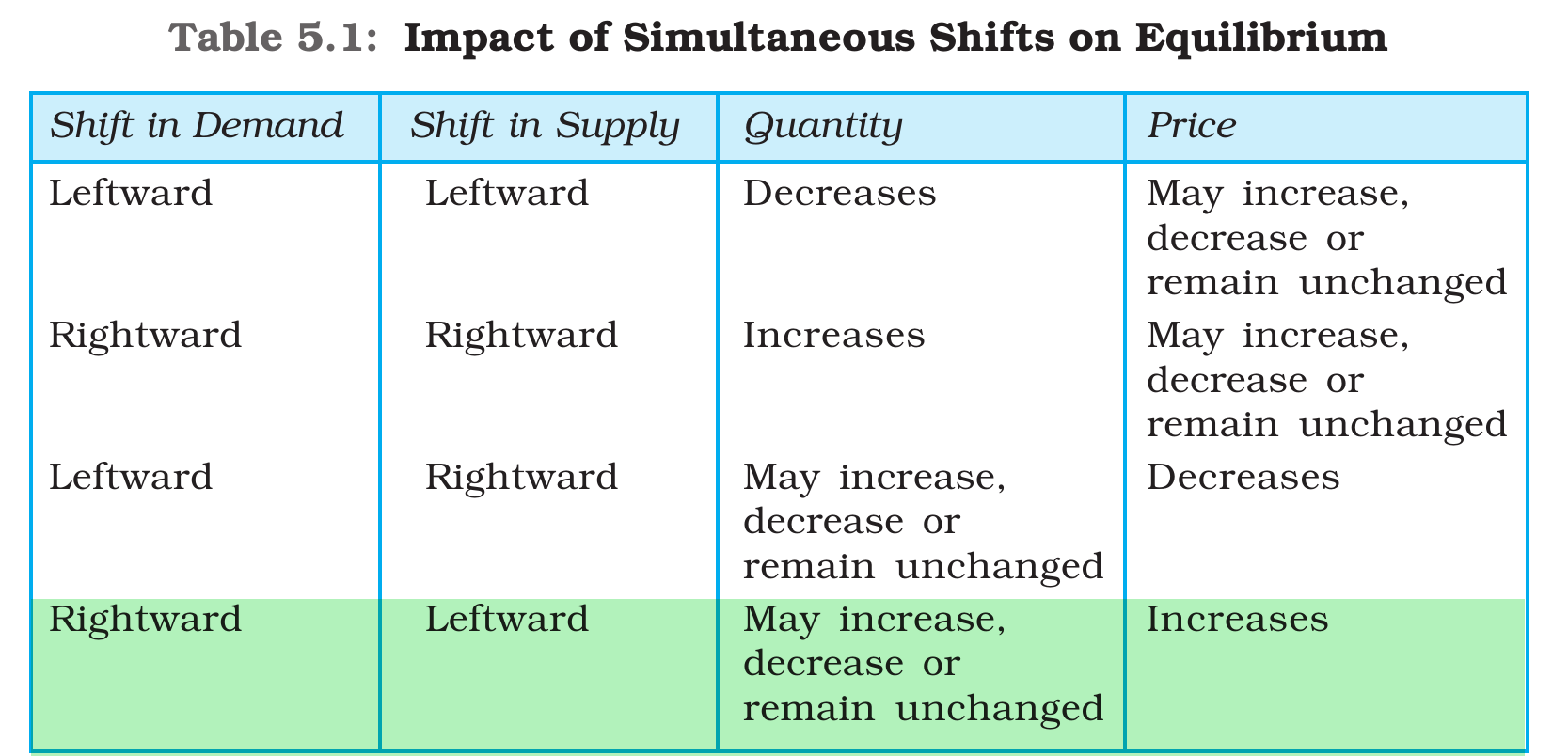
When the supply curve shifts leftward and the demand curve shifts rightward, the equilibrium price increases. Both shifts push the price the same way.

  • A rightward shift of demand means buyers want more at the old price. This creates excess demand, and the price rises.

  • A leftward shift of supply means sellers offer less at the old price. This also creates excess demand, and the price rises.

The price can go either way only when both curves shift in the same direction. In the case asked here, the quantity may increase, decrease or remain unchanged. This depends on the size of the two shifts.

NCERT (2026-27): Introductory Microeconomics — Chapter 5: Market Equilibrium

NCERT extract

NCERT extract

NCERT extract

Advertisement

Practise more on Micro Economics: Market Equilibrium

Chapter-wise mocks on the real NTA exam screen, with solutions and your rank. Your first mocks are free.

Start free mocks →

Advertisement

Next questions

  1. Assertion (A): Different people behave in different ways in a given situation, but the behaviour of a particular person from one situation…Psychology · Self and Personality
  2. The probabilities of a student getting I, II and III division in an examination are respectively 1/10, 3/5 and 1/4. The probability that th…Maths. Section A · Probability
  3. Select the word similar in meaning to the given word.TEMPERATEEnglish · Synonyms
  4. Human communication occurs on what levels: a) Intra personal, b) Interpersonal, c) Academic d) PublicPsychology · Developing Psychological Skills
  5. The idea of 'imagined community' was given by:Sociology · Social Change and Development in India: Mass Media and Communication
  6. How many Indian States and Union Territories share their borders with Afghanistan?General Aptitude Test · General Knowledge
  7. Three identical dice are thrown together. The probability that distinct numbers appear on them, isMaths. Section B1 · Probability
  8. What was Sacha's reaction on seeing her parents at the hostel ? She was __________.English · Comprehension - (Narrative / Factual)
  9. Identify the order of the two reactions whose rate constants are given below: (i) k = 2.3 × 10^-5 L mol ^-1 s^-1 (ii) k= 3 × 10^-4 s^-1Chemistry · Physical: Chemical Kinetics
  10. What is the term used to describe all animals that rely on plants, either directly or indirectly, for their food?Biology · Ecosystem