
CUETMOCK
  • Pricing
  • Mentors
Log inStart freeStart free mocks→

First test, then trust

Try a free CUET mock test.

Join 5,00,000+ students who rehearsed exam day on the exact NTA screen before sitting CUET. On the web and on Android.

Start free mocks →Get the Android app
CUETMOCK

India's #1 CUET Mock Test Platform. Original NCERT-based questions on the exact NTA exam screen — trusted by 5,00,000+ students since CUET 2022.

Get it onGoogle PlayScan to download the CUETMOCK app

Mock tests

  • CUET mock test series
  • Browse all papers
  • Commerce mocks
  • Humanities (Arts) mocks
  • Science mocks
  • Languages & GAT mocks
  • Free practice questions
  • Pricing

Resources

  • CUET exam guide
  • CUET syllabus
  • Universities accepting CUET
  • Expert blogs
  • News & notifications
  • Webinars & counselling
  • CUET score calculator
  • How we estimate your rank
  • FAQs

Company

  • About us
  • Our leadership & team
  • Our toppers
  • Mentors
  • For schools
  • Contact us
  • Terms
  • Privacy
  • Refund policy

Talk to us

+91 7696 6630 56info@cuetmock.comWhatsApp us

Our other platforms

  • JEE Mock — For IIT-JEE aspirants
  • NEET Mock — For NEET aspirants

Newsletter

Exam updates, study material and offers — no spam.

© 2026 NYC Ventures Pvt. Ltd.

701-702, Royal Business Park, Zirakpur, Punjab - 140603

  • Terms of use
  • Privacy policy
  • Refund policy
  • Contact us

iCUETMOCK is an independent preparation platform, not affiliated with the National Testing Agency (NTA). Always check exam details on the official NTA website.

  • Home
  • Mock tests
  • CUET guide
  • Pricing
  • Log in
Home/Practice questions/Chemistry
ChemistryPhysical: Chemical Kinetics

Identify the order of the two reactions whose rate constants are give…

Identify the order of the two reactions whose rate constants are given below:

(i) \( k = 2.3 × 10^{-5}\, L\, mol\,^{-1} s^{-1} \)
(ii) \( k= 3 × 10^{-4} s^{-1} \)

Answer & explanation+

Correct answer: option 2

The correct answer is Option (2) → (i) Second order, (ii) First order

The unit of a rate constant shows the order of the reaction. For rate \( = k[\mathrm{A}]^{n} \):

    \( \displaystyle k = \frac{\text{rate}}{[\mathrm{A}]^{n}} = \frac{\mathrm{mol\,L^{-1}\,s^{-1}}}{(\mathrm{mol\,L^{-1}})^{n}} = (\mathrm{mol\,L^{-1}})^{1-n}\,\mathrm{s^{-1}} \)

This gives mol L−1 s−1 for zero order, s−1 for first order and L mol−1 s−1 for second order.

  • (i) \( k = 2.3 \times 10^{-5}\ \mathrm{L\,mol^{-1}\,s^{-1}} \): here \( (\mathrm{mol\,L^{-1}})^{1-n} = (\mathrm{mol\,L^{-1}})^{-1} \), so 1 − n = −1 and n = 2, a second order reaction.

  • (ii) \( k = 3 \times 10^{-4}\ \mathrm{s^{-1}} \): no concentration term, so 1 − n = 0 and n = 1, a first order reaction.

So (i) is second order and (ii) is first order. The numerical values of k play no part; only the units decide the order.

Note: This question is from NCERT (2026-27). NTA sets numerical questions from NCERT too, so do not ignore NCERT while practising numericals.

NCERT (2026-27 edition):
Order of a Reaction – …
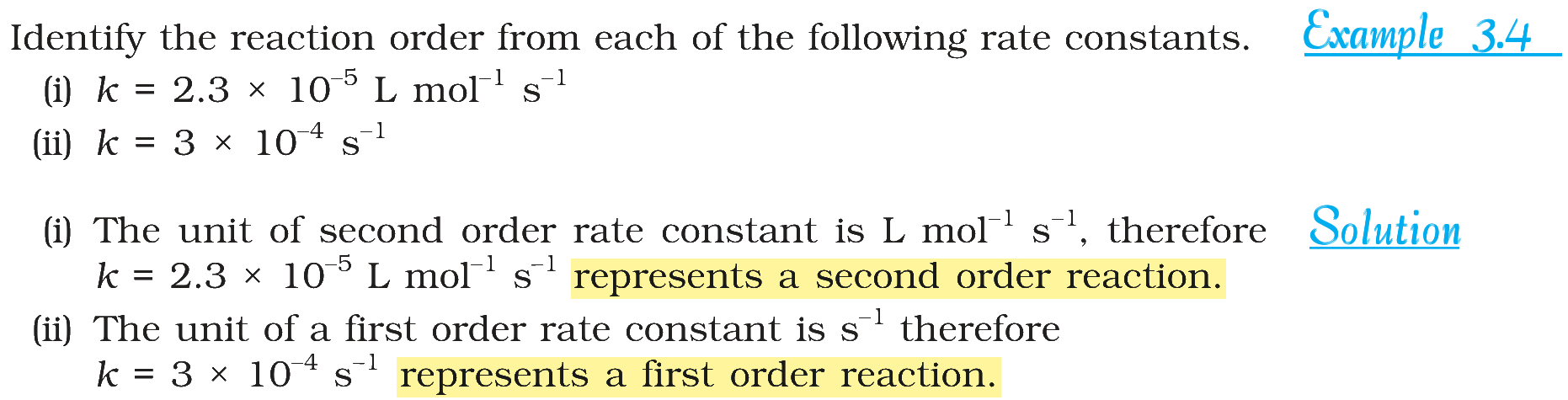
Textbook extract

Advertisement

Practise more on Physical: Chemical Kinetics

Chapter-wise mocks on the real NTA exam screen, with solutions and your rank. Your first mocks are free.

Start free mocks →

Advertisement

Next questions

  1. What is the term used to describe all animals that rely on plants, either directly or indirectly, for their food?Biology · Ecosystem
  2. What are the products obtained in the chemical reaction?Chemistry · Organic: Alcohols, Phenols and Ethers
  3. Who is known as the Father of "Indian Space Program"?General Aptitude Test · General Knowledge
  4. Choose the word that can substitute the given group of words. One who adapts oneself readily to various situationsEnglish · One Word
  5. Ajay wishes to invest ₹1,50,000 in treasury bills. What are the maximum number of treasury bills he can buy with his fund?Business Studies · Financial Markets
  6. A resistance of 2Ω is connected across one gap of a metre-bridge (the length of the wire is 100 cm) and an unknown resistance, greater than…Physics · Current Electricity
  7. In a thermite process, the reducing agent isChemistry · Inorganic: General Principles and Processes of Isolation of Elements
  8. Match List – I with List – II. LIST I LIST II A. Straight line method I. Amount of depreciation remains constant from year to year B. Writt…Accountancy · Depreciation, Provisions and Reserves
  9. The country that makes the maximum contribution to the World Bank isPolitical Science · Contemporary World Politics: International Organisations
  10. Arrange the events in chronological order: (A) Champaran Movement.(B) Jallianwala Bagh Massacre.(C) Chauri Chaura Incident.(D) Workers' Mov…History · Modern India: Mahatma Gandhi and the Nationalist movement