
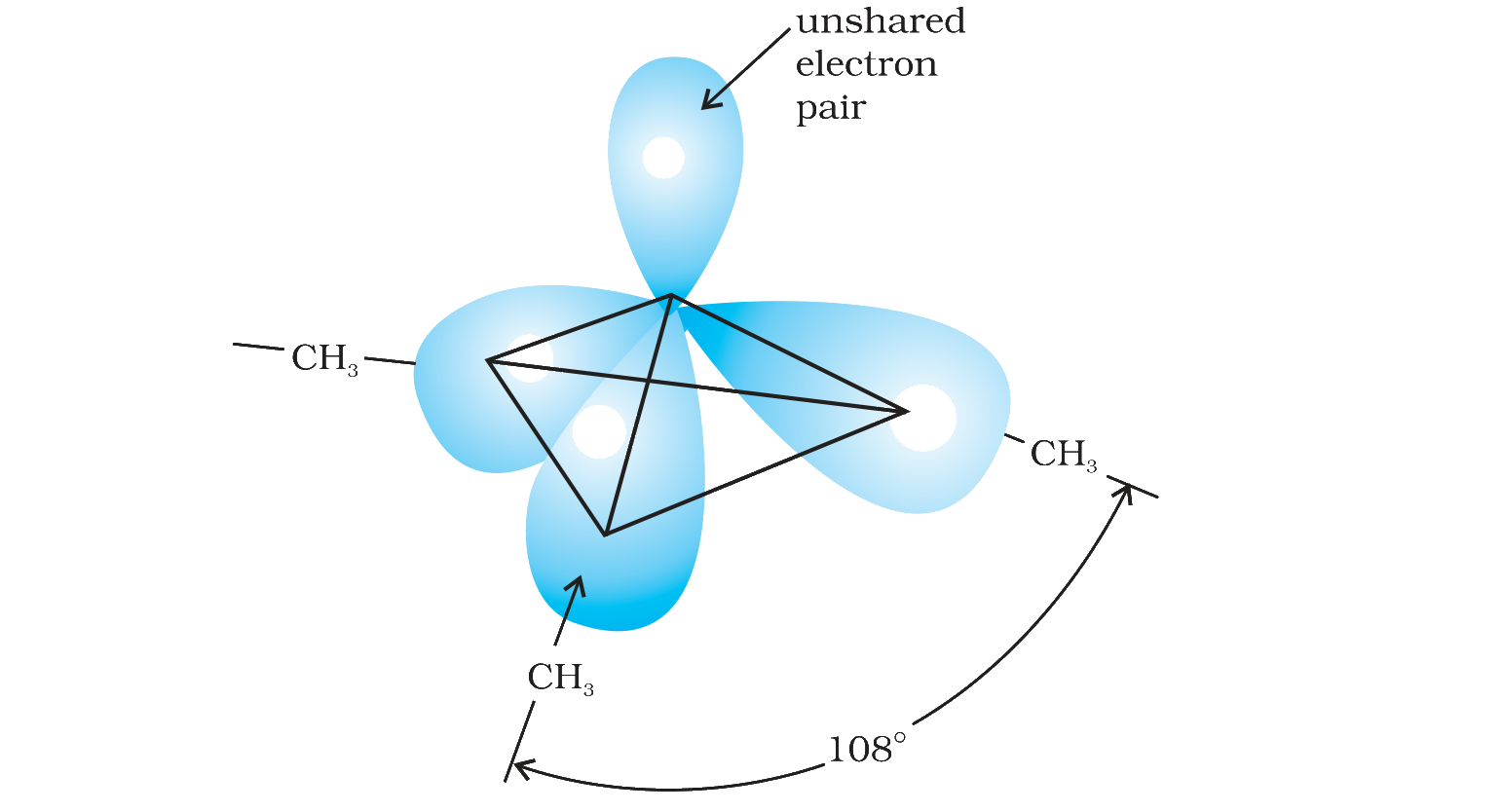
The figure shows the structure of the trimethylamine molecule.
What is the hybridisation of the nitrogen atom, and which orbital of nitrogen holds the unshared electron pair?
Answer & explanation
Correct answer: option 4
The correct answer is Option (4) → sp3; the fourth sp3 orbital
The figure shows four lobes around nitrogen, pointing towards the corners of a tetrahedron. Three of them overlap with the three CH3 groups, and the fourth is labelled unshared electron pair.
Hybridisation of nitrogen — sp3. Four orbitals of the same kind, three bonding and one holding a lone pair, are sp3 hybrid orbitals. The resulting geometry is pyramidal, with a C–N–C angle of 108°.
Orbital of the unshared pair — the fourth sp3 orbital. The lobe of the unshared pair has the same shape as the three bonding lobes, so it is one of the sp3 orbitals.
Why the other options are incorrect
Option (1) sp2; an unhybridised p orbital — Incorrect. An sp2 nitrogen would be planar with 120° angles; the figure shows a pyramid with 108°.
Option (2) sp3; an unhybridised p orbital — Incorrect. An sp3 nitrogen has no unhybridised p orbital left; all four orbitals are hybridised.
Option (3) sp2; one of the three sp2 orbitals — Incorrect. Nitrogen forms three bonds and also holds a lone pair, so it needs four orbitals, not three.
NCERT (2026-27 edition):
9.1 Structure of Amines – “Like ammonia, nitrogen atom of amines is trivalent and carries an unshared pair of electrons. Nitrogen orbitals in amines are therefore, sp3 hybridised and the geometry of amines is pyramidal. Each of the three sp3 hybridised orbitals of nitrogen overlap with orbitals of hydrogen or carbon depending upon the composition of the amines. The fourth orbital of nitrogen in all amines contains an unshared pair of electrons. Due to the presence of unshared pair of electrons, the angle C–N–E, (where E is C or H) is less than 109.5°; for instance, it is 108° in case of trimethylamine as shown in Fig. 9.1.”
Fig. 9.1: Pyramidal shape of trimethylamine