CUETMOCK
  • Pricing
  • Mentors
Log inStart freeStart free mocks→

First test, then trust

Try a free CUET mock test.

Join 5,00,000+ students who rehearsed exam day on the exact NTA screen before sitting CUET. On the web and on Android.

Start free mocks →Get the Android app
CUETMOCK

India's #1 CUET Mock Test Platform. Original NCERT-based questions on the exact NTA exam screen — trusted by 5,00,000+ students since CUET 2022.

Get it onGoogle PlayScan to download the CUETMOCK app

Mock tests

  • CUET mock test series
  • Browse all papers
  • Commerce mocks
  • Humanities (Arts) mocks
  • Science mocks
  • Languages & GAT mocks
  • Free practice questions
  • Pricing

Resources

  • CUET exam guide
  • CUET syllabus
  • Universities accepting CUET
  • Expert blogs
  • News & notifications
  • Webinars & counselling
  • CUET score calculator
  • How we estimate your rank
  • FAQs

Company

  • About us
  • Our leadership & team
  • Our toppers
  • Mentors
  • For schools
  • Contact us
  • Terms
  • Privacy
  • Refund policy

Talk to us

+91 7696 6630 56info@cuetmock.comWhatsApp us

Our other platforms

  • JEE Mock — For IIT-JEE aspirants
  • NEET Mock — For NEET aspirants

Newsletter

Exam updates, study material and offers — no spam.

© 2026 NYC Ventures Pvt. Ltd.

701-702, Royal Business Park, Zirakpur, Punjab - 140603

  • Terms of use
  • Privacy policy
  • Refund policy
  • Contact us

iCUETMOCK is an independent preparation platform, not affiliated with the National Testing Agency (NTA). Always check exam details on the official NTA website.

  • Home
  • Mock tests
  • CUET guide
  • Pricing
  • Log in
Home/Practice questions/Sociology
SociologyIndian Society: Continuity and Change

Which kind of form of family is reflected in Khasi society? A. Matril…

Which kind of form of family is reflected in Khasi society?

A. Matrilocal
B. Matrilineal
C. Matriarchal
D. Patrilocal
E. Patrilineal

Choose the correct answer from the options given below:

Answer & explanation+

Correct answer: option 1

The correct answer is Option (1) → B and A only

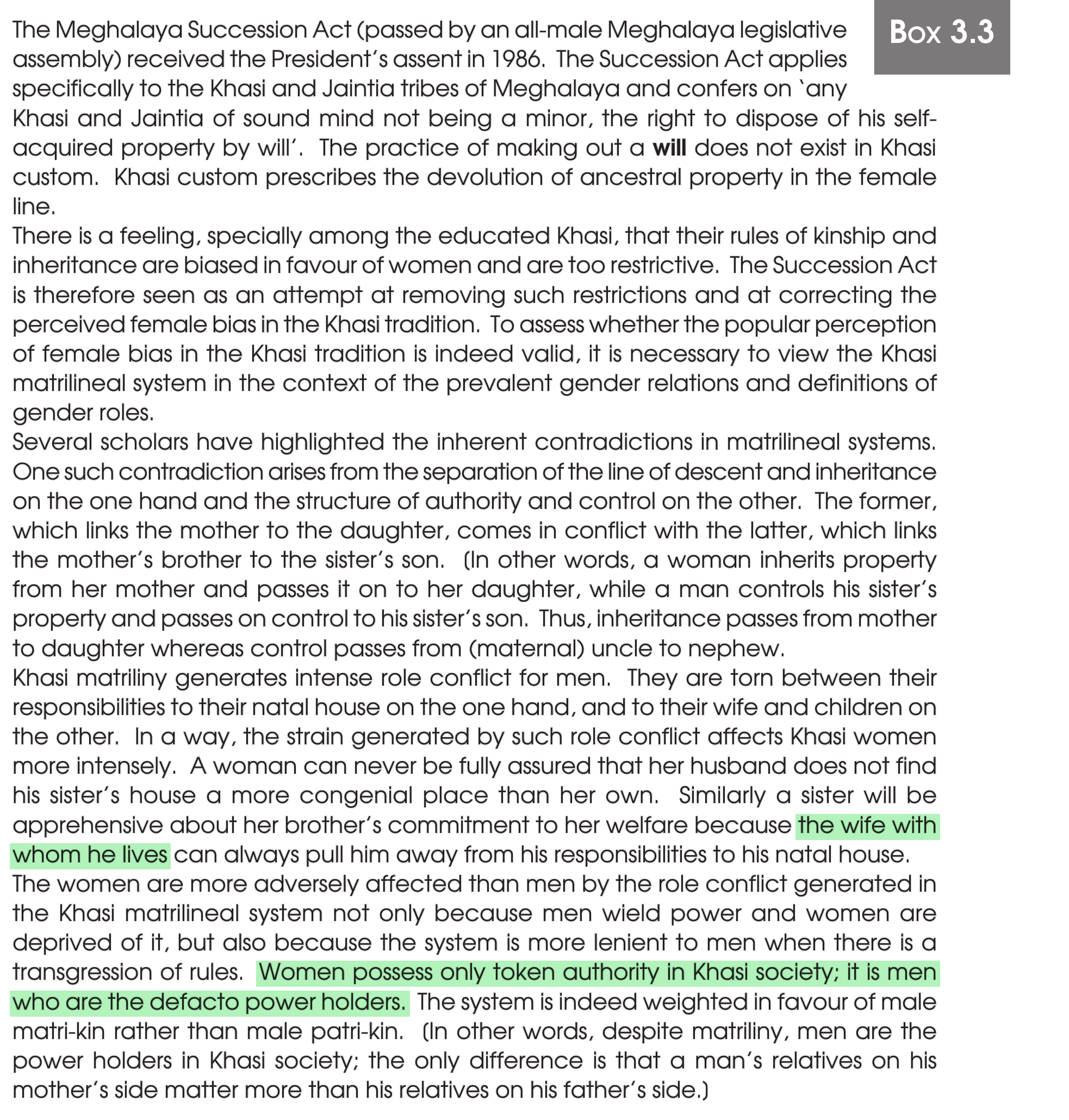
A. Matrilocal Correct. In a matrilocal society the newly married couple stays with the woman’s parents. A Khasi man lives in his wife’s house, which is why the wife with whom he lives can pull him away from his duties to his natal house.

B. Matrilineal Correct. A matrilineal society passes on property from mother to daughter. Khasi custom prescribes the devolution of ancestral property in the female line.

C. Matriarchal Incorrect. Matriarchy, where women exercise dominance, has been a theoretical rather than an empirical concept. Khasi women possess only token authority; men are the de facto power holders, so the Khasi are matrilineal, not matriarchal.

D. Patrilocal Incorrect. In a patrilocal society the couple lives with the man’s parents, the opposite of the Khasi rule.

E. Patrilineal Incorrect. A patrilineal society passes on property from father to son; among the Khasi it passes from mother to daughter.

Note: Box 3.3 on the Khasi matrilineal family, in the chapter ‘Social Institutions: Continuity and Change’, was there in the pre-rationalised NCERT, which NTA followed in 2023. This box has been deleted from the NCERT book (2025-26), though the chapter and its section on the diverse forms of the family are still there.


NCERT (2025-26): “The Diverse Forms of the Family … Studies have shown how diverse family forms are found in different societies. With regard to the rule of residence, some societies are matrilocal in their marriage and family customs while others are patrilocal. In the first case, the newly married couple stays with the woman’s parents, whereas in the second case the couple lives with the man’s parents. With regard to the rules of inheritance, matrilineal societies pass on property from mother to daughter while patrilineal societies do so from father to son. A patriarchal family structure exists where the men exercise authority and dominance, and matriarchy where the women play a similarly dominant role. However, matriarchy – unlike patriarchy – has been a theoretical rather than an empirical concept. There is no historical or anthropological evidence of matriarchy – i.e., societies where women exercise dominance. However, there do exist matrilineal societies, i.e., societies where women inherit property from their mothers but do not exercise control over it, nor are they the decision makers in public affairs.”

NCERT extract

Box 3.3, Khasi matrilineal family (Pre-rationalised NCERT)

Advertisement

Practise more on Indian Society: Continuity and Change

Chapter-wise mocks on the real NTA exam screen, with solutions and your rank. Your first mocks are free.

Start free mocks →

Advertisement

Next questions

  1. Select the most more appropriate option to fill in the blank.That week the dollar dropped _______ its lowest levels.English · Fill Blanks
  2. Which of the following cities is known as the 'Cashew Capital of the World'?General Aptitude Test · General Knowledge
  3. The food served for lunch was INSIPID. Rewrite the given sentence by giving the antonym to the underlined word.The food served for lunch wa…English · Antonyms
  4. The table given below shows the number of male teacher and female teachers in 5 schools. Schools Male teachers female teachers L 160 180 M…General Aptitude Test · Quantitative Reasoning
  5. Which of the following is correct for this workshop?Economics · Micro Economics: Production and Costs
  6. In amines, the nitrogen atom is A and B hybridized, making geometry of amines as C. Then A, B and C respectively are:Chemistry · Organic: Amines
  7. Which of the following option will replace the question mark? MAD: JXA :: RUN ?General Aptitude Test · General Ability
  8. In each of the following question, a statement of Assertion (A) is given followed by a corresponding statement of Reason (R). Choose the co…Chemistry · Inorganic: P Block Elements
  9. Right to Education was added as a fundamental right in the Indian Constitution in ______.General Aptitude Test · General Knowledge
  10. The radii of two cylinders A and B are in the ratio of 5 : 6 and the heights are in the ratio of 7 : 4 respectively. The ratio of the curve…General Aptitude Test · Quantitative Reasoning