Which reagent will distinguish Benzophenone from acetone?
Answer & explanation
Correct answer: option 4
The correct answer is Option (4) → \(I_2/NaOH\)
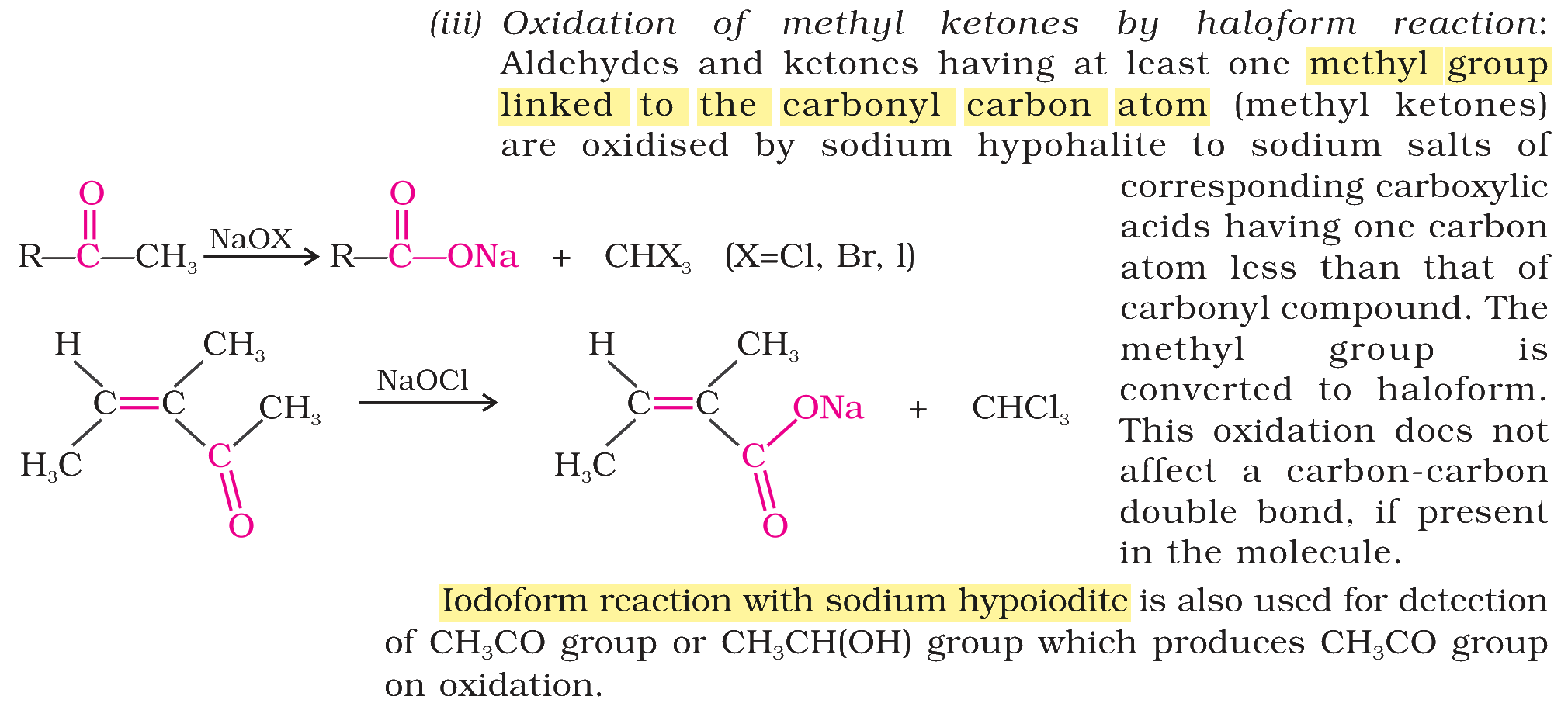
The iodoform test detects the \( \ce{CH3CO-} \) group. A methyl ketone (or acetaldehyde) is oxidised by sodium hypoiodite, formed from iodine and sodium hydroxide; the \( \ce{CH3} \) group is converted into iodoform, a yellow precipitate, and the rest of the molecule becomes the salt of a carboxylic acid with one carbon atom less.
Acetone is a methyl ketone, so it gives the test:
\( \displaystyle \ce{CH3COCH3 + 3I2 + 4NaOH -> CHI3 v + CH3COONa + 3NaI + 3H2O} \)
Benzophenone, \( \ce{C6H5COC6H5} \), has no methyl group on the carbonyl carbon, so it gives no yellow precipitate. So \( \ce{I2/NaOH} \) distinguishes the two.
Why the other options are incorrect
Option (1) Fehling’s reagent — Incorrect. It is reduced only by aliphatic aldehydes; both compounds here are ketones, so neither reacts.
Option (2) Tollen’s reagent — Incorrect. It is reduced by aldehydes (silver mirror); ketones such as acetone and benzophenone do not react, so it cannot tell them apart.
Option (3) 2,4-DNP reagent — Incorrect. It reacts with the C=O group of every aldehyde and ketone to give a coloured 2,4-dinitrophenylhydrazone, so both compounds give a positive test.
NCERT (2026-27 edition):
Oxidation of Methyl Ketones by Haloform Reaction