Peasants Movements have been taking place since pre-independent India. Arrange chronologically from oldest to newest.
(A) Bengal Revolt
(B) Bardoli Satyagraha
(C) Naxal Movement
(D) New Farmer's Movement
(E) Telengana Movement
Choose the correct answer from the options given below:
Answer & explanation
Correct answer: option 3
The correct answer is Option (3) → (A), (B), (E), (C), (D)
(A) Bengal Revolt — 1859-62, against the indigo plantation system.
(B) Bardoli Satyagraha — 1928, a ‘non-tax’ campaign in Surat district.
(E) Telengana Movement — 1946-51, at the time of Independence, against feudal conditions in Hyderabad.
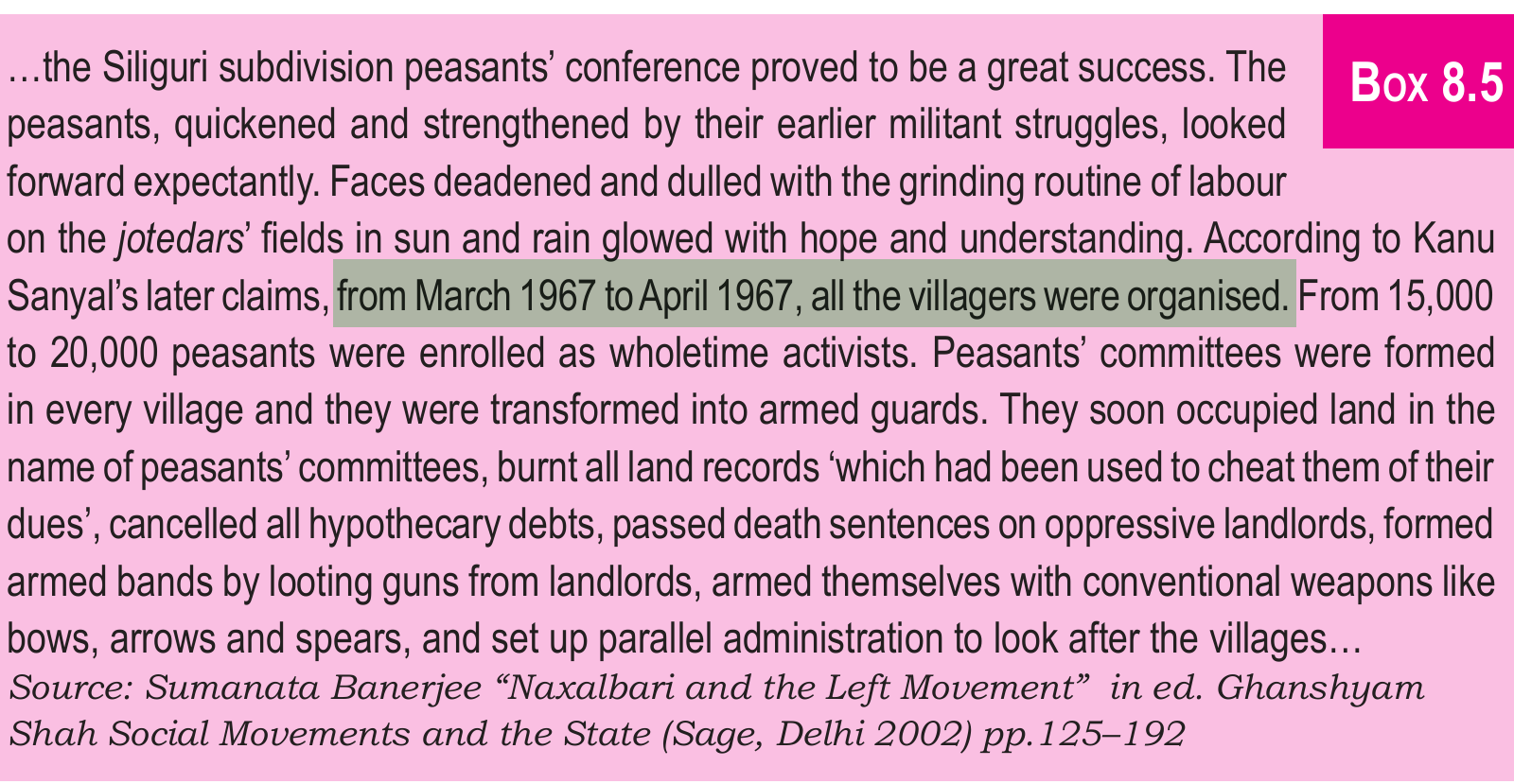
(C) Naxal Movement — the peasants of the Naxalbari area were organised from March 1967.
(D) New Farmer’s Movement — began in the 1970s in Punjab and Tamil Nadu.
NCERT (2025-26): “8.5 Class Based Movements … The movements in the period between 1858 and 1914 tended to remain localised, disjointed and confined to particular grievances. Well-known are the Bengal revolt of 1859-62 against the indigo plantation system and the ‘Deccan riots’ of 1857 against moneylenders. Some of these issues continued into the following period, and under the leadership of Mahatma Gandhi became partially linked to the Independence movement. For instance, the Bardoli Satyagraha (1928, Surat District) a ‘non-tax’ campaign as part of the nationwide non-cooperation movement, a campaign of refusal to pay land revenue and the Champaran Satyagraha (1917–18) directed against indigo plantations. In the 1920s, protest movements against the forest policies of the British government and local rulers arose in certain regions. Recall our discussion on structural changes in Chapter 1. Between 1920 and 1940 peasant organisations arose. The first organisation to be founded was the Bihar Provincial Kisan Sabha (1929), and in 1936 the All India Kisan Sabha. The peasants organised by the Sabhas demanded freedom from economic exploitation for peasants, workers and all other exploited classes. At the time of Independence, we had the two most classical cases of peasant movements, namely the Tebhaga movement (1946–47) and the Telangana movement (1946–51). The first was a struggle of sharecroppers in Bengal in North Bihar for two thirds share of their produce instead of the customary half. It had the support of the Kisan Sabha and the Communist Party of India (CPI). The second was directed against the feudal conditions in the princely state of Hyderabad and was led by the CPI. New farmer’s movements began in the 1970s in Punjab and Tamil Nadu.…”
Box 8.5 (Naxalbari, 1967) |