Particulate air pollutants from a thermal power plant are removed by:
Answer & explanation
Correct answer: option 3
The correct answer is Option (3) → Electrostatic precipitator
Option (1) Catalytic converters — Incorrect. They are fitted in automobiles to convert unburnt hydrocarbons, CO and nitric oxide into harmless gases.
Option (2) Scrubbers — Incorrect. A scrubber removes gases such as sulphur dioxide, not particles.
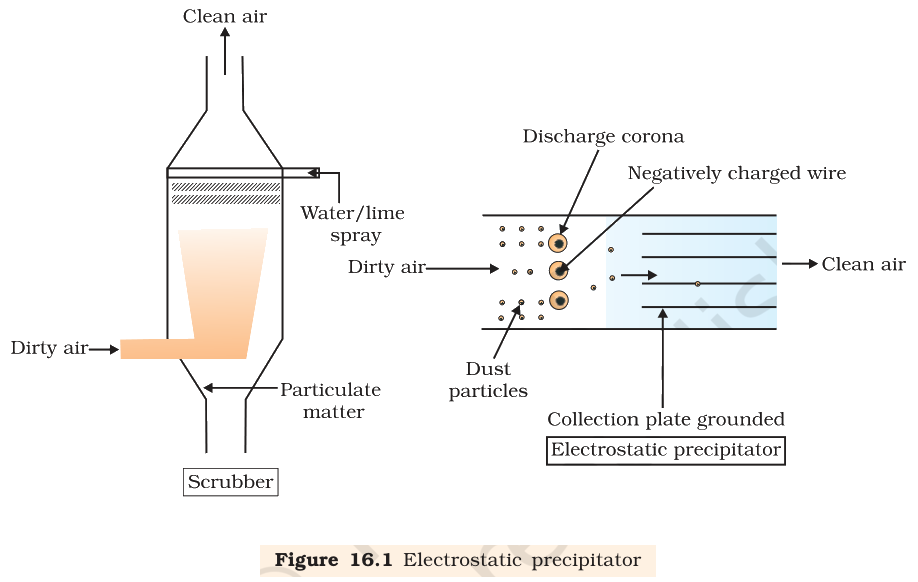
Option (3) Electrostatic precipitator — Correct. Charged dust particles are attracted to grounded plates; it removes over 99 per cent of the particulate matter.
Option (4) Filtration — Incorrect. NCERT names the electrostatic precipitator as the most widely used method.
Note: This question is from Chapter 16, Environmental Issues, of the pre-rationalised NCERT book. This chapter is not in the present NCERT book (2026-27). The extract below is from the pre-rationalised edition.
NCERT Extract (Pre-rationalised edition, Chapter 16, Environmental Issues):
Air Pollution and Its Control – “… There are several ways of removing particulate matter; the most widely used of which is the electrostatic precipitator (Figure 16.1), which can remove over 99 per cent particulate matter present in the exhaust from a thermal power plant. It has electrode wires that are maintained at several thousand volts, which produce a corona that releases electrons.”