Impact of urbanization on peripheral villages:
A. People build fashionable houses
B. Pressure on resources
C. Conflicts between migrants and villagers
D. Out migration
E. Uprooting villagers from their land
Choose the correct answer from the options given below:
Answer & explanation
Correct answer: option 3
The correct answer is Option (3) → A, B, C, E only
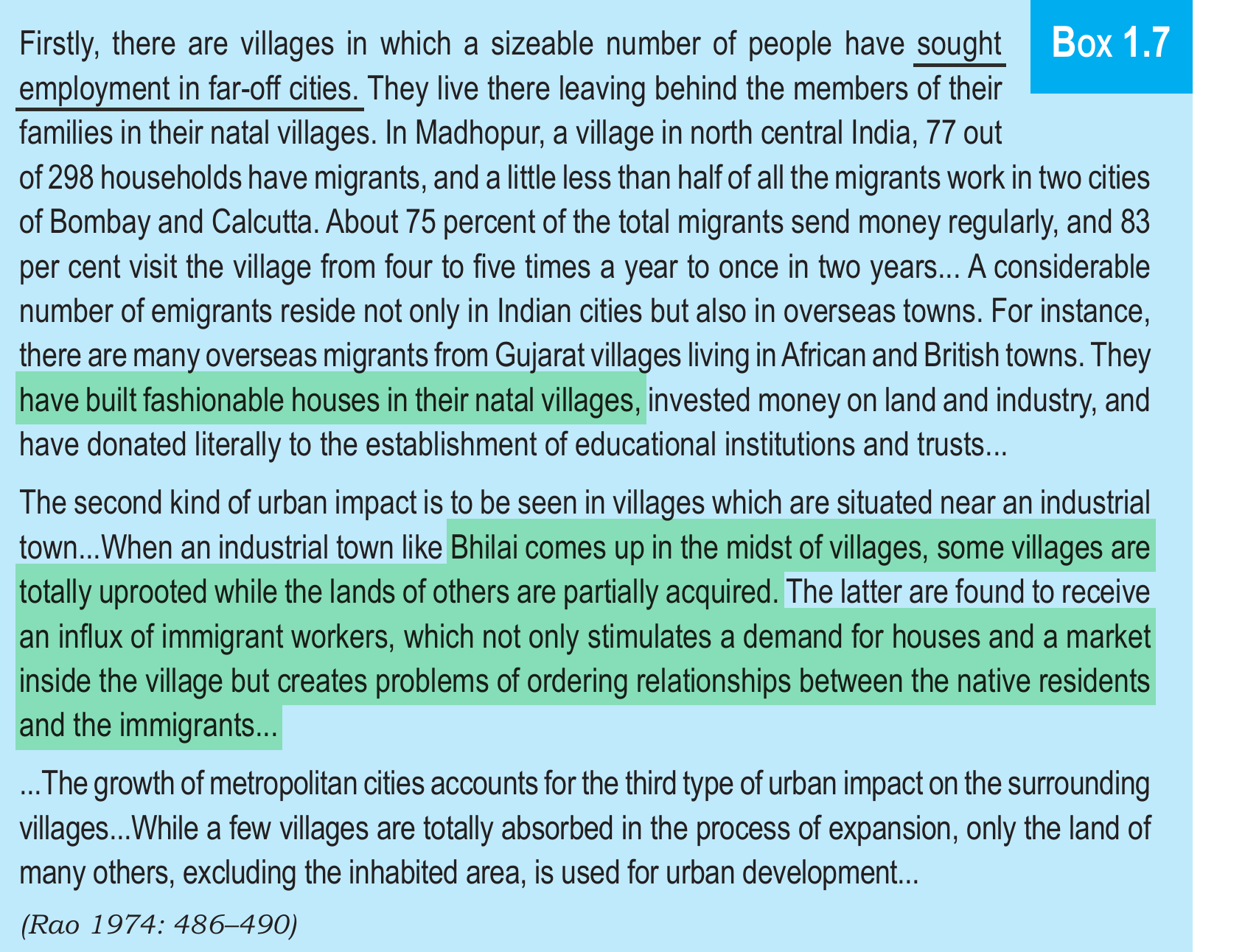
A. People build fashionable houses Correct. Money earned in cities and towns changes the look of the villages it reaches: emigrants have built fashionable houses in their villages and invested in land and industry. Near an industrial town, the influx of workers also stimulates a demand for houses inside the village.
B. Pressure on resources Correct. When an industrial town comes up among villages, the lands of the villages around it are acquired, and an influx of immigrant workers stimulates a demand for houses and a market inside the village. Land, housing and other resources come under pressure.
C. Conflicts between migrants and villagers Correct. The influx creates problems of ordering relationships between the native residents and the immigrants.
D. Out migration Incorrect. Villages near an industrial town or a growing city receive an influx of immigrants; people move in, not out. Out-migration marks a different kind of village, one from which people have sought employment in far-off cities.
E. Uprooting villagers from their land Correct. When an industrial town like Bhilai comes up in the midst of villages, some villages are totally uprooted; around metropolitan cities a few villages are totally absorbed, and the land of many others is used for urban development.
Note: In NCERT, the fashionable houses (statement A) are built by emigrants in their natal villages, the first of M.S.A. Rao’s three kinds of urban impact, while the villages around an industrial town or a metropolitan city receive immigrants. The answer is marked as per the NTA answer key.
NCERT: Social Change and Development in India — Chapter 1: Structural Change, Box 1.7 (2025-26)
|