Match List-I with List-II
|
List-I |
List-II |
|
(A) Fermentation of glucose |
(I) Invertase |
|
(B) Methanol |
(II) Zymase |
|
(C) Ethanol |
(III) Poisonous even in small amounts |
|
(D) Fermentation of sucrose |
(IV) Solvent in paint industry |
Choose the correct answer from the options given below:
Answer & explanation
Correct answer: option 2
The correct answer is Option (2) → (A) - (II), (B) - (III), (C) - (IV), (D) - (I)
Each List-I item is matched by the enzyme that acts on it or by the property the alcohol is known for.
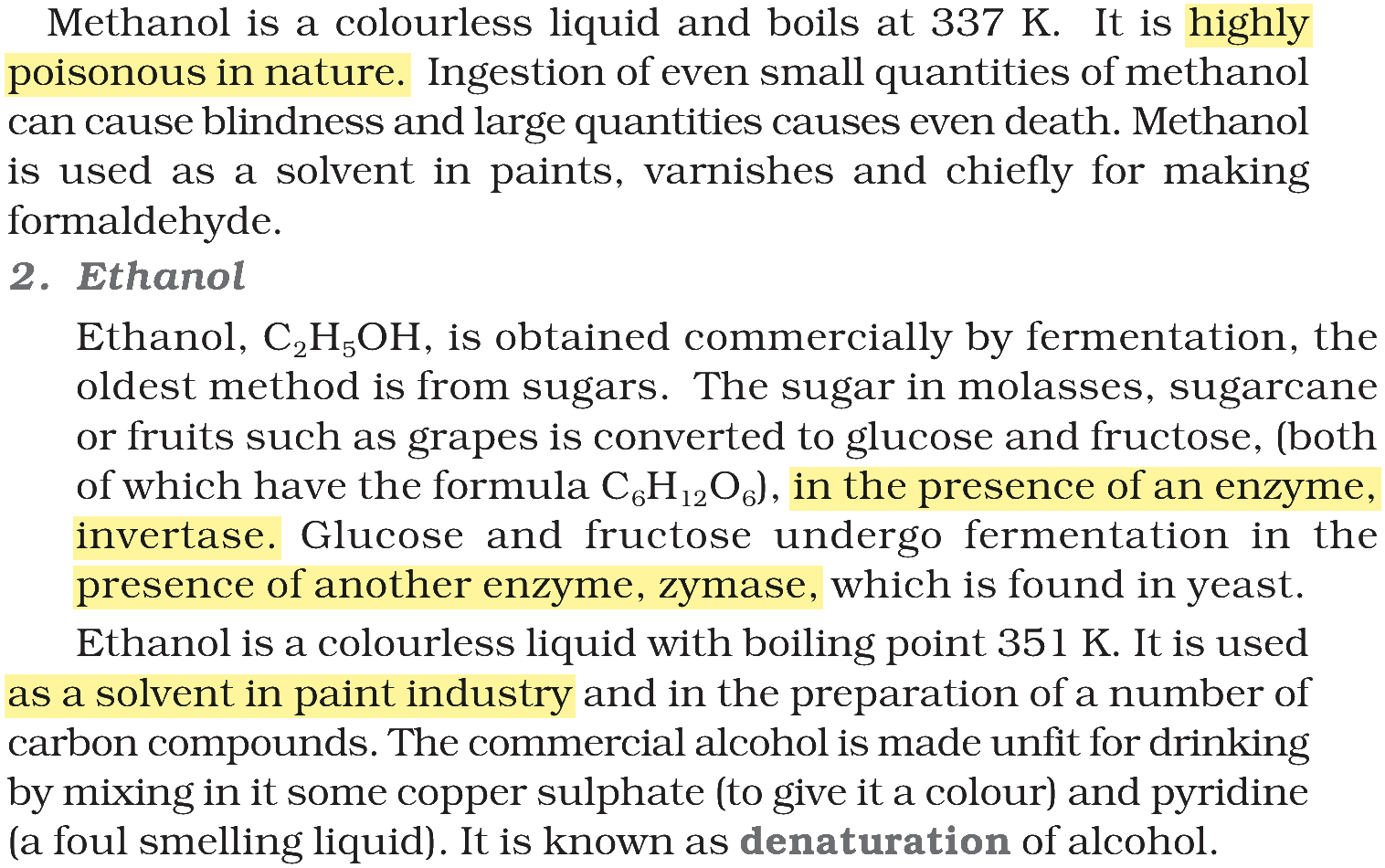
(A) Fermentation of glucose — This matches (II) Zymase. Zymase, found in yeast, converts glucose (and fructose) into ethanol under anaerobic conditions.
\( \displaystyle \ce{C6H12O6} \xrightarrow{\text{zymase}} \ce{2C2H5OH + 2CO2} \)
(B) Methanol — This matches (III) Poisonous even in small amounts. Drinking even small quantities of methanol can cause blindness, and larger quantities cause death. Methanol is also a solvent for paints, but only methanol is poisonous even in small amounts, so (B) takes (III) and ethanol takes (IV).
(C) Ethanol — This matches (IV) Solvent in paint industry. Ethanol is used as a solvent in the paint industry and in making many carbon compounds.
(D) Fermentation of sucrose — This matches (I) Invertase. Sucrose must first be hydrolysed; invertase splits it into glucose and fructose, which zymase then ferments.
\( \displaystyle \ce{C12H22O11 + H2O} \xrightarrow{\text{invertase}} \ce{C6H12O6}\,(\text{glucose}) + \ce{C6H12O6}\,(\text{fructose}) \)
Shortcut: (A)-(II) appears only in Option (2), so no other pair needs checking.
NCERT (2026-27 edition):
Some Commercially Important Alcohols – …