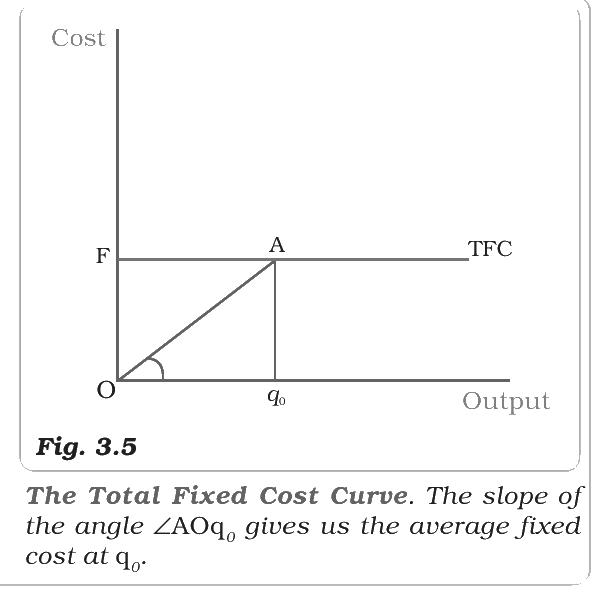
On the total fixed cost (TFC) curve, A is the point at output q0. The average fixed cost at q0 is given by:
Answer & explanation
Correct answer: option 3
The correct answer is Option (3) → tan of the angle AOq0 (the slope of OA)
AFC is TFC divided by output. At q0, TFC is the height Aq0 and output is Oq0. So AFC = Aq0/Oq0, which is tan of the angle AOq0, the slope of the line OA.
Option (1) the height OF of the TFC curve at q0 — OF is the TFC itself, not the AFC.
Option (2) the area under the TFC curve up to q0 — this area is not used for AFC; AFC comes from the angle at O.
Option (4) the slope of the TFC curve at the point A — the TFC line is flat, so its own slope is zero.
Note: A whole question can hide in one small angle of a figure. NTA likes such corners, so read every figure with the lines beside it.
NCERT (2026-27): “Shapes of the Short Run Cost Curves … We can also calculate AFC from TFC curve. In Figure 3.5, the horizontal straight line cutting the vertical axis at F is the TFC curve. At q0 level of output, total fixed cost is equal to OF. At q0, the corresponding point on the TFC curve is A. Let the angle ∠AOq0 be θ. The AFC at q0 is AFC = TFC/quantity = Aq0/Oq0 = tanθ”
|