Which of the following complexes can show facial and meridional isomerism?
Answer & explanation
Correct answer: option 2
The correct answer is Option (2) → [Co(NH3)3(NO2)3]
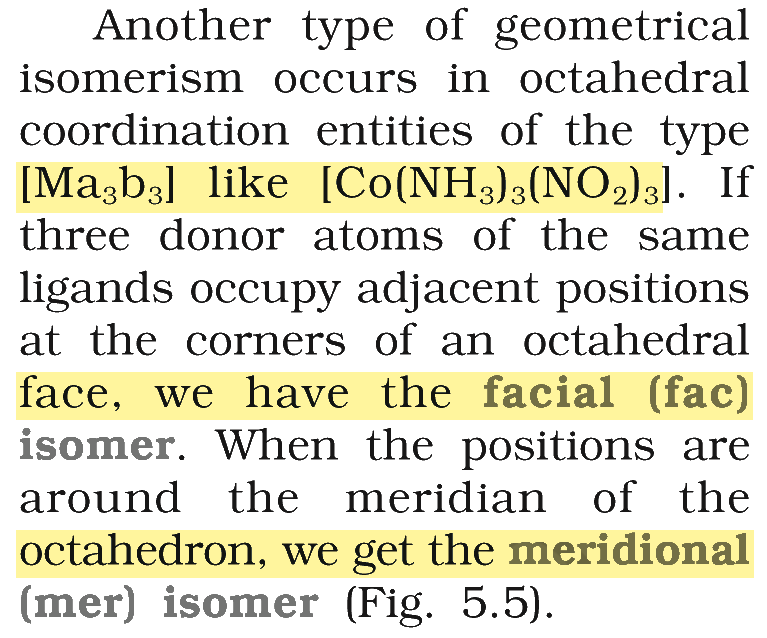
Facial–meridional (fac–mer) isomerism is a kind of geometrical isomerism shown by octahedral complexes of the type [MA3B3]:
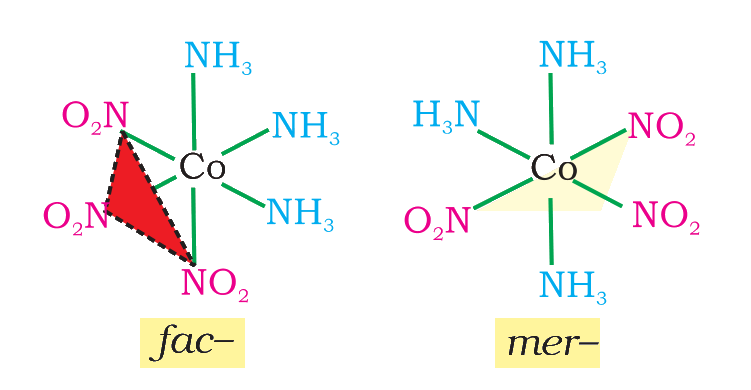
fac isomer: the three identical ligands occupy the three corners of one face of the octahedron; each is cis (90°) to the other two.
mer isomer: the three identical ligands lie in a line around the meridian of the octahedron; two of them are trans (180°) to each other.
Other octahedral types show different isomerism: [MA4B2] and [M(AA)2B2] show cis–trans isomerism, and [MA5B] shows no geometrical isomerism at all.
\( \ce{[Co(NH3)3(NO2)3]} \) has three \( \ce{NH3} \) and three \( \ce{NO2^{-}} \) ligands around \( \ce{Co^{3+}} \), so it is of the [MA3B3] type and shows fac and mer isomers.
Why the other options are incorrect
Option (1) [Co(NH3)5(NO2)]Cl2 — Incorrect. It is [MA5B], with no geometrical isomers. It does show linkage isomerism (nitro, –\( \ce{NO2} \), and nitrito, –ONO) and ionisation isomerism.
Option (3) [CrCl2(ox)2]3− — Incorrect. It is [M(AA)2B2], which shows cis–trans isomerism; the cis form is also optically active.
Option (4) [Pt(en)2Cl2] — Incorrect. It is also of the [M(AA)2B2] type, so it shows cis–trans isomerism, not fac–mer.
NCERT (2026-27 edition):
Geometric Isomerism – …