Vitamins and Nucleic Acids
Vitamins are organic compounds required in the diet in small amounts to perform specific biological functions for normal maintenance of optimum growth and health of the organism. Vitamins are designated by alphabets A, B, C, D, etc. Some of them are further named as sub-groups e.g. B1 , B2 , B6 , B12 , etc. Excess of vitamins is also harmful and vitamin pills should not be taken without the advice of doctor. Vitamins are classified into two groups depending upon their solubility in water or fat. Vitamins A, D, E and K are fat and oils soluble. They are stored in liver and adipose tissues. Vitamins B and C groups are soluble in water. Water soluble vitamins must be supplied regularly in diet because they are readily excreted in urine and can not be stored (except vitamin B12) in our body. Deficiency of vitamins causes various diseases.
Nucleic acids ( DNA and RNA) are basis of heredity . They are made of four bases, adenine, guanine, cytosine and thymine which combine with sugar molecule beta-D-2-deoxyribose and phosphate group. Base , sugar and phosphate group form nucleotide unit which is building block of DNA molecule. Two nucleic acid chains are wound about each other and held together by hydrogen bonds between pairs of bases . These two strands are complementary to each other because the hydrogen bonds are formed between specific pairs of bases. Adenine forms hydrogen bonds with thymine whereas cytosine forms hydrogen bonds with guanine.
Proteins are the most abundant biomolecules of the living system. Amino acids contain amino group and carboxyl functional group. Depending upon the relative position of amino group with respect to carboxyl group, the amino acids can be classified into alpha, beta and so on. Only alpha amino acids are obtained on hydrolysis of protein. The side chain of amino acid is variable which are non-polar, polar and basic in nature.
Consider the double helix structure for DNA. The base pairs are:
Answer & explanation
Correct answer: option 2
The correct answer is Option (2) → Inside the helix
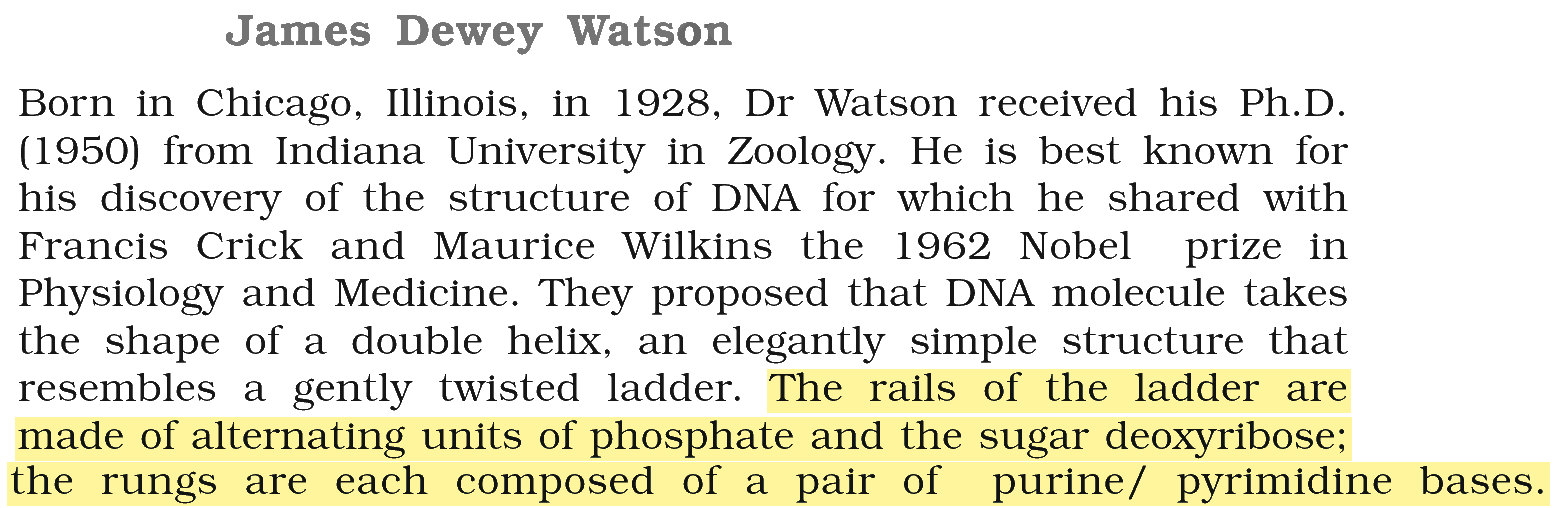
In the double helix proposed by Watson and Crick, DNA consists of two polynucleotide strands coiled around a common axis:
Backbone: alternating sugar (β-D-2-deoxyribose) and phosphate units form the outside of each strand.
Bases: attached to the sugars, they point inwards into the helix, where each base pairs with a base of the other strand by hydrogen bonds.
Base pairing: adenine pairs with thymine, and cytosine pairs with guanine.
These hydrogen-bonded base pairs are stacked one above another inside the helix and hold the two strands together.
Why the other options are incorrect
Option (1) Part of the backbone structure — Incorrect. The backbone is made only of sugar and phosphate units; the bases are attached to it and do not form part of it.
Option (3) outside the helix — Incorrect. The outside of the helix is the sugar–phosphate backbone.
Option (4) Not present in helix — Incorrect. The base pairs are essential to the helix, since their hydrogen bonds hold the two strands together.
Note: It seems that there is a mistake in the original NTA paper, which says that nucleic acids (DNA and RNA) are made of adenine, guanine, cytosine and thymine with the sugar β-D-2-deoxyribose, when this is true only for DNA; RNA contains uracil in place of thymine and β-D-ribose as its sugar.
NCERT (2026-27 edition):
James Dewey Watson