
Read the passage and answer the following questions.
Flowering plants employ various mechanisms to discourage self-pollination and promote cross-pollination. These mechanisms include temporal separation of pollen release and stigma receptivity, spatial separation of anther and stigma, self-incompatibility, and the production of unisexual flowers. In some species, the timing of pollen release and stigma receptivity is not synchronised. This prevents self-pollination as either the pollen is released before the stigma becomes receptive or the stigma becomes receptive before the pollen is released. Similarly, in other species, the anther and stigma are positioned in a way that prevents self-pollination by avoiding contact between the pollen and stigma of the same flower. Self-incompatibility is a genetic mechanism that prevents self-pollen, whether from the same flower or other flowers of the same plant, from fertilising the ovules. It achieves this by inhibiting pollen germination or pollen tube growth in the pistil. The production of unisexual flowers is another device to prevent self-pollination. For example, in plants like castor and maize, which are monoecious, having both male and female flowers on the same plant prevents self-pollination (autogamy) but not pollination between flowers on the same plant (geitonogamy). On the other hand, in species like papaya, male and female flowers are present on different plants (dioecy), effectively preventing both autogamy and geitonogamy. During pollination, the pistil may encounter pollen of the wrong type, either from other species or from the same plant if it is self-incompatible. The pistil has the ability to recognise whether the pollen is of the right type (compatible) or the wrong type (incompatible). If the pollen is compatible, the pistil accepts it and promotes post-pollination events leading to fertilisation. However, if the pollen is incompatible, the pistil rejects it by preventing pollen germination on the stigma or pollen tube growth in the style. The recognition and acceptance or rejection of pollen by the pistil involve a continuous dialogue between the pollen grain and the pistil. This dialogue is facilitated by chemical components present in both the pollen and pistil. In recent years, scientists have made progress in identifying some of these components and understanding the interactions that lead to the recognition, acceptance, or rejection of pollen by the pistil.
Which type of pollination is functionally cross-pollination involving a pollinating agent, but genetically similar to autogamy?
Answer & explanation
Correct answer: option 2
The correct answer is Option (2) → Geitonogamy
Pollination is named by where the pollen comes from. In autogamy the pollen reaches the stigma of the same flower. In geitonogamy it reaches another flower of the same plant. In xenogamy it reaches a flower of a different plant. “Functionally” asks how the pollen travels; “genetically” asks whose genes the pollen carries.
Option (1) Xenogamy — Incorrect. Xenogamy brings pollen from a different plant. It is the only type that brings genetically different pollen to the stigma, so it is cross-pollination both functionally and genetically.
Option (2) Geitonogamy — Correct. The pollen moves from one flower to another, so it needs a pollinating agent, just as in cross-pollination. But both flowers are on the same plant, so the pollen carries the plant’s own genes, as in autogamy. This is why monoecious plants such as castor and maize, named in the passage, avoid autogamy but not geitonogamy.
Option (3) Cleistogamy — Incorrect. Cleistogamous flowers never open. Their anthers and stigma lie close together and pollen falls on the stigma inside the closed bud. No agent is involved, so it is not functionally cross-pollination; it is always autogamy.
Option (4) Chasmogamy — Incorrect. Chasmogamous flowers are ordinary open flowers with exposed anthers and stigma. The term names a kind of flower, not a type of pollen transfer.
NCERT Extract:
Pollination – “… Some plants such as Viola (common pansy), Oxalis, and Commelina produce two types of flowers – chasmogamous flowers which are similar to flowers of other species with exposed anthers and stigma, and cleistogamous flowers which do not open at all (Figure 1.9c). … (ii) Geitonogamy – Transfer of pollen grains from the anther to the stigma of another flower of the same plant. Although geitonogamy is functionally cross-pollination involving a pollinating agent, genetically it is similar to autogamy since the pollen grains come from the same plant.
(iii) Xenogamy – Transfer of pollen grains from anther to the stigma of a different plant (Figure 1.9b). This is the only type of pollination which during pollination brings genetically different types of pollen grains to the stigma.”
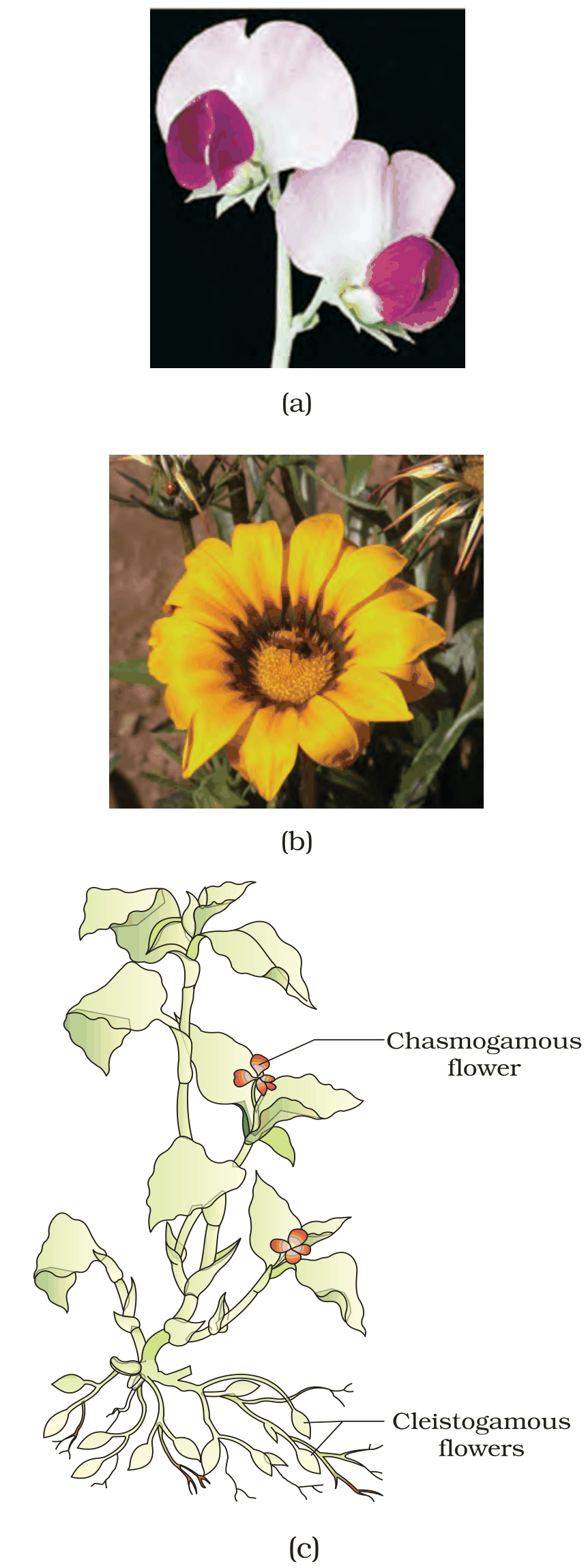
Figure 1.9 (a) Self-pollinated flowers; (b) Cross pollinated flowers; (c) Cleistogamous flowers