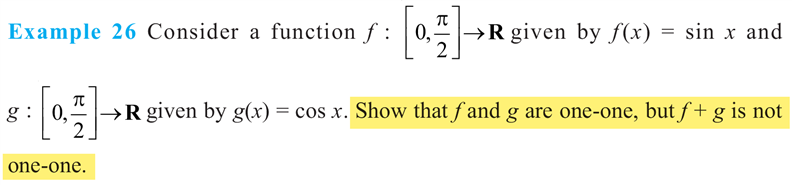
Consider a function \( f:\left[0,\displaystyle\frac{\pi}{2}\right]\to R \) given by \( f(x)=\sin x \) and \( g:\left[0,\displaystyle\frac{\pi}{2}\right]\to R \) given by \( g(x)=\cos x \), where \( R \) is set of real numbers then which of the following are correct?
A. \( f \) is one-one
B. \( g \) is one-one
C. \( f+g \) is one-one
D. \( f+g \) is not one-one
Choose the correct answer from the options given below:
Answer & explanation
Correct answer: option 2
The correct answer is Option (2) → A, B and D only
On \( \left[0,\frac{\pi}{2}\right] \), sin x is strictly increasing and cos x is strictly decreasing, so each takes every value only once. For f + g:
\( (f+g)(0)=0+1=1 \)
\( \displaystyle (f+g)\left(\frac{\pi}{2}\right)=1+0=1 \)
So f and g are one-one, but f + g takes the value 1 at both x = 0 and \( x=\frac{\pi}{2} \).
Checking the statements
(A) \( f \) is one-one — Correct. sin x is strictly increasing on \( \left[0,\frac{\pi}{2}\right] \).
(B) \( g \) is one-one — Correct. cos x is strictly decreasing on \( \left[0,\frac{\pi}{2}\right] \).
(C) \( f+g \) is one-one — Incorrect. \( (f+g)(0)=(f+g)\left(\frac{\pi}{2}\right)=1 \).
(D) \( f+g \) is not one-one — Correct. Two different inputs, 0 and \( \frac{\pi}{2} \), both give 1.
NCERT (2026-27 edition):
Composition of Functions and Invertible Function