
Solve the following Linear Programming Problem graphically: Maximise: $Z = -x + 2y$, Subject to the constraints: $x \ge 3, x + y \ge 5, x + 2y \ge 6, y \ge 0$.
Answer & explanation
Correct answer: option 4
The correct answer is Option (4) → No maximum value ##
The feasible region determined by the constraints, $x \ge 3$, $x + y \ge 5$, $x + 2y \ge 6$, $y \ge 0$ is given below.
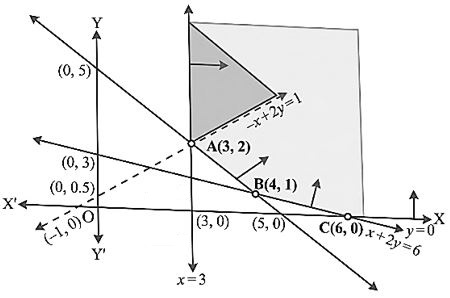
Here, it can be seen that the feasible region is unbounded.
The values of $Z$ at corner points $A(3, 2)$, $B(4, 1)$ and $C(6, 0)$ are given below.
|
Corner point |
Corresponding value of $Z=−x+2y$ |
|
$A(3, 2)$ |
$1$ (may or may not be the maximum value) |
|
$B(4, 1)$ |
$-2$ |
|
$C(6, 0)$ |
$-6$ |
Since the feasible region is unbounded, $Z = 1$ may or may not be the maximum value.
Now, we draw the graph of the inequality, $-x + 2y > 1$, and we check whether the resulting open half-plane has any point/s in common with the feasible region or not.
Here, the resulting open half-plane has points in common with the feasible region.
Hence, $Z = 1$ is not the maximum value. We conclude $Z$ has no maximum value.