Find the returns to scale for the following Cobb-Douglas production function.
Q=L1/3K3/4
Answer & explanation
Correct answer: option 1
The correct answer is Option (1) → Increasing returns to scale
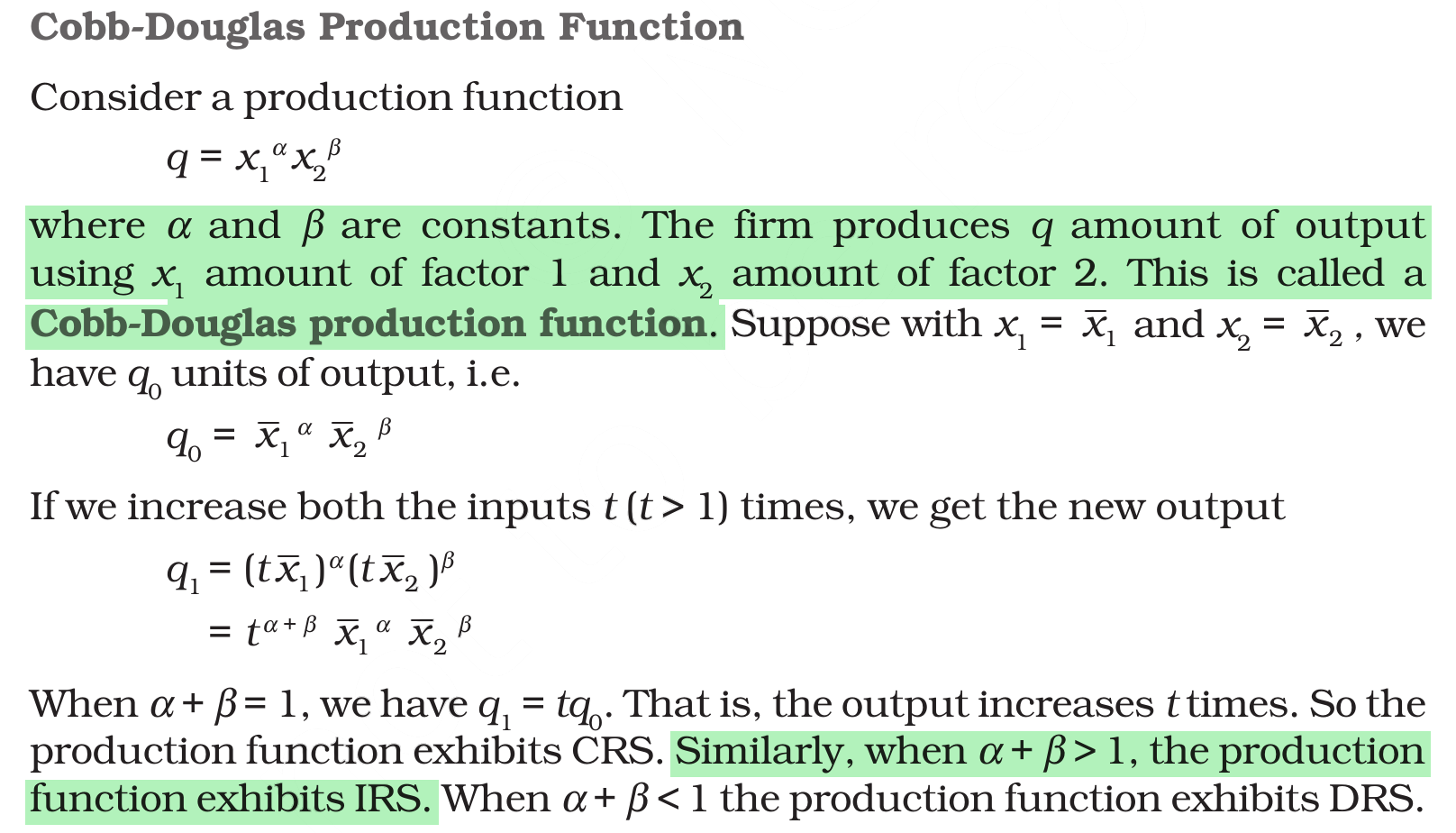
Economists often describe a firm’s production with a Cobb-Douglas production function, of the form q = x1αx2β, where α and β are constants: the firm produces q units of output using x1 units of factor 1 and x2 units of factor 2. These powers decide how output responds when both inputs grow together, so their sum, α + β, tells us the returns to scale.
Here Q = L1/3K3/4 is of this form, with labour (L) and capital (K) as the two factors. Its returns to scale are found by increasing both inputs by the same factor t (t > 1) and seeing how output changes.
Given:
Q = L1/3K3/4, so α = 1/3 and β = 3/4
Multiply both inputs by t:
New output = (tL)1/3(tK)3/4
= t1/3 × t3/4 × L1/3K3/4
= t1/3 + 3/4 × Q
1/3 + 3/4 = 4/12 + 9/12 = 13/12
New output = t13/12 × Q
13/12 > 1, so t13/12 > t: output increases more than t times
Result: increasing returns to scale
The working shows the general rule behind the definition: α + β = 1 gives constant, α + β > 1 increasing and α + β < 1 decreasing returns to scale.
NCERT: Introductory Microeconomics — Chapter 3: Production and Costs (2025-26)
|