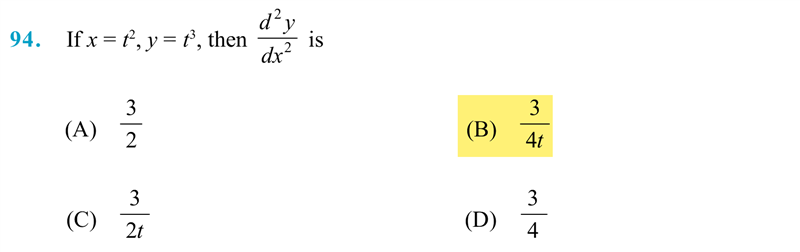
If \( x=t^2,y=t^3 \), then \( \displaystyle\frac{d^2y}{dx^2} \) is equal to:
Answer & explanation
Correct answer: option 4
The correct answer is Option (4) → \( \displaystyle\frac{3}{4t} \)
Since x and y are given in terms of t,
\( \displaystyle \frac{dy}{dx}=\frac{3t^2}{2t}=\frac{3t}{2} \)
For the second derivative, the chain rule brings in \( \frac{dt}{dx}=\frac{1}{2t} \):
\( \displaystyle \frac{d^2y}{dx^2}=\frac{d}{dt}\left(\frac{3t}{2}\right)\times\frac{dt}{dx} \)
\( \displaystyle =\frac{3}{2}\times\frac{1}{2t} \)
\( \displaystyle =\frac{3}{4t} \)
Why the other options are incorrect
Option (1) \( \displaystyle\frac{3t}{2} \) — Incorrect. This is only \( \frac{dy}{dx} \).
Option (2) \( \displaystyle\frac{3}{2t} \) — Incorrect. The value is \( \frac{3}{4t} \), not \( \frac{3}{2t} \).
Option (3) \( \displaystyle\frac{3}{2} \) — Incorrect. This differentiates \( \frac{3t}{2} \) with respect to t but forgets to multiply by \( \frac{dt}{dx}=\frac{1}{2t} \).
NCERT Exemplar:
Continuity and Differentiability