
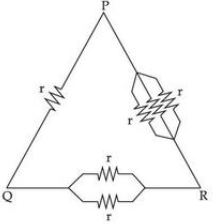
Six equal resistances are connected between points P, Q and R as shown in the figure. The net resistance will be maximum between:
Answer & explanation
Correct answer: option 1
The correct answer is Option (1) → P and Q
Between any two corners, the arm joining them directly is in parallel with the series combination of the other two arms. So each arm is first reduced to one resistance.
From the figure:
\( \text{arm PQ: one resistor} \Rightarrow R_{PQ}' = r \)
\( \text{arm QR: two resistors in parallel} \Rightarrow R_{QR}' = r/2 \)
\( \text{arm PR: three resistors in parallel} \Rightarrow R_{PR}' = r/3 \)
Between P and Q, the arm \( r \) is in parallel with \( r/3 + r/2 = 5r/6 \):
\( \displaystyle R_{\mathrm{PQ}} = \frac{r \times \frac{5r}{6}}{r + \frac{5r}{6}} = \frac{5r}{11} \)
Between Q and R, the arm \( r/2 \) is in parallel with \( r + r/3 = 4r/3 \):
\( \displaystyle R_{\mathrm{QR}} = \frac{\frac{r}{2} \times \frac{4r}{3}}{\frac{r}{2} + \frac{4r}{3}} = \frac{4r}{11} \)
Between P and R, the arm \( r/3 \) is in parallel with \( r + r/2 = 3r/2 \):
\( \displaystyle R_{\mathrm{PR}} = \frac{\frac{r}{3} \times \frac{3r}{2}}{\frac{r}{3} + \frac{3r}{2}} = \frac{3r}{11} \)
The largest of \( 5r/11 \), \( 4r/11 \) and \( 3r/11 \) is \( 5r/11 \), between P and Q.
Shortcut: The sum of the three arms is the same for every pair, \( r + r/2 + r/3 = 11r/6 \), so each net resistance is (direct arm) \( \times \) (sum of the other two) \( \div \, 11r/6 \). This product is largest for the arm \( r \), the one with the largest direct resistance, so P and Q give the maximum.