Read the passage and answer the questions:
Images of the Revolt of 1857
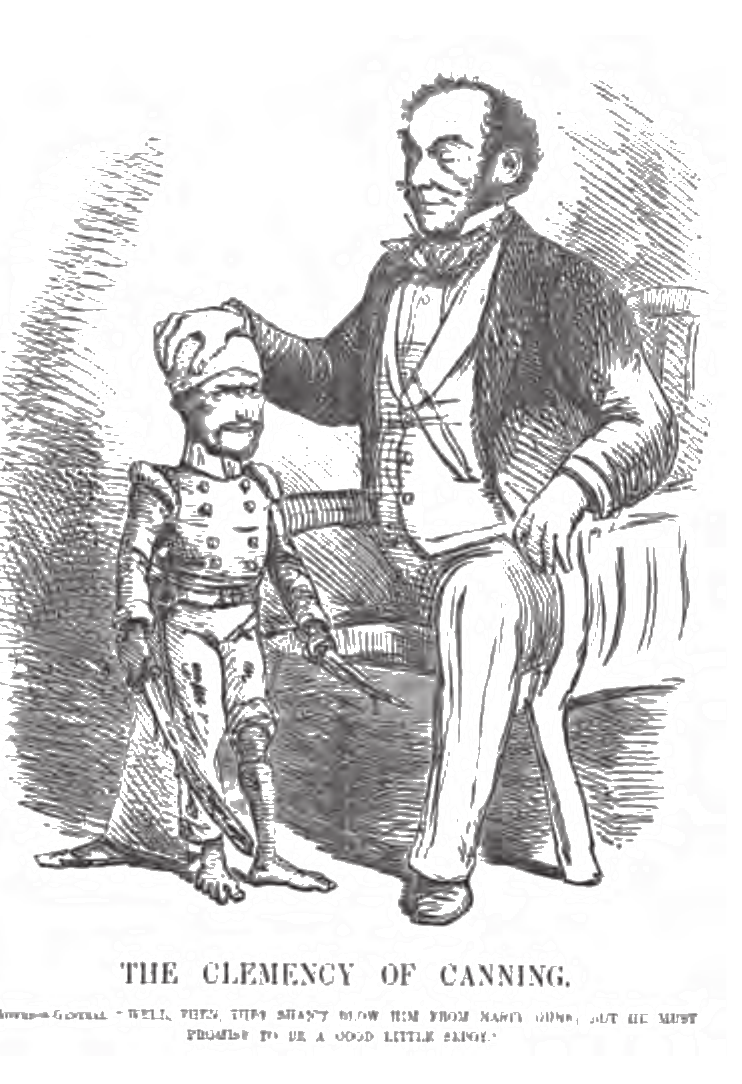
Newspaper reports have a power over public imagination; they shape feelings and attitudes to events. Inflamed particularly by tales of violence against women and children, there were public demands in Britain for revenge and retribution. The British government was asked to protect the honour of innocent women and ensure the safety of helpless children. Artists expressed as well as shaped these sentiments through their visual representations of trauma and suffering.... "In Memoriam" was painted by Joseph Noel Paton two years after the mutiny. It does not show gory violence; it only suggests it. It stirs up the spectator's imagination, and seeks to provoke anger and fury. Miss Wheeler stands firmly at the centre, defending her honour, single-handedly killing the attacking rebels. In one of the cartoons published in the pages of Punch, a British journal of comic satire, Canning is shown as a looming father figure, with his protective hand over the head of a sepoy....Art and literature, as much as the writing of history, have helped in keeping alive the memory of 1857. Rani of Jhansi was represented as a masculine figure chasing the enemy, slaying British soldiers and valiantly fighting till her last. Children in many parts of India grow up reading the lines of Subhadra Kumari Chauhan: "... Like a man she fought, she was the Rani of Jhansi". In popular prints Rani Lakshmi Bai is usually portrayed in battle armour, with a sword in hand and riding a horse - a symbol of the determination to resist injustice and alien rule.
A British journal illustrated a cartoon/sketch captioned, "Well, then they shan't blow him from nasty guns; but he must promise to be a good little sepoy". Identify the illustration.
Answer & explanation
Correct answer: option 3
The correct answer is Option (3) → The Clemency of Canning
The cartoon “The Clemency of Canning” appeared in Punch, a British journal of comic satire, on 24 October 1857. It shows Governor General Canning as a looming father figure with his protective hand over the head of a sepoy, and its caption reads: “Well, then they shan’t blow him from nasty guns; but he must promise to be a good little sepoy”.
NCERT (2026-27): “5.5 No time for clemency … At a time when the clamour was for vengeance, pleas for moderation were ridiculed. When Governor General Canning declared that a gesture of leniency and a show of mercy would help in winning back the loyalty of the sepoys, he was mocked in the British press. In one of the cartoons published in the pages of Punch, a British journal of comic satire, Canning is shown as a looming father figure, with his protective hand over the head of a sepoy who still holds an unsheathed sword in one hand and a dagger in the other, both dripping with blood (Fig.10.17) – an imagery that recurs in a number of British pictures of the time.…”
Fig. 10.17 “The Clemency of Canning”, Punch, 24 October 1857 |