
In the following figure ABCDEF is a regular hexagon. If $\overrightarrow{A B}=\vec{a}$ and $\overrightarrow{\mathrm{BC}}=\overrightarrow{\mathrm{b}}$ then $\overrightarrow{\mathrm{CD}}$ in terms of a and b is :
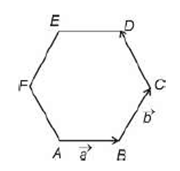
Answer & explanation
Correct answer: option 3
The correct answer is option (3) → \(\vec{b} - \vec{a}\)
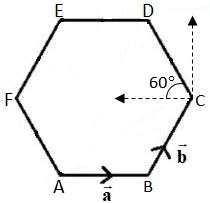
Expressing $\vec{CD}$ in terms of $\vec a$ and $\vec b$
$\vec{CD}=α\vec a+β\vec b$
$\langle -\frac{1}{2},\frac{\sqrt{3}}{2} \rangle=α\langle 1,0 \rangle+β\langle \frac{1}{2},\frac{\sqrt{3}}{2} \rangle$
$α+\frac{β}{2}=-\frac{1}{2}$ ...(1)
$\frac{\sqrt{3}}{2}β=\frac{\sqrt{3}}{2}$ ...(2)
From (1) and (2),
$β=1,α=-1⇒\vec{CD}=\vec b - \vec a$