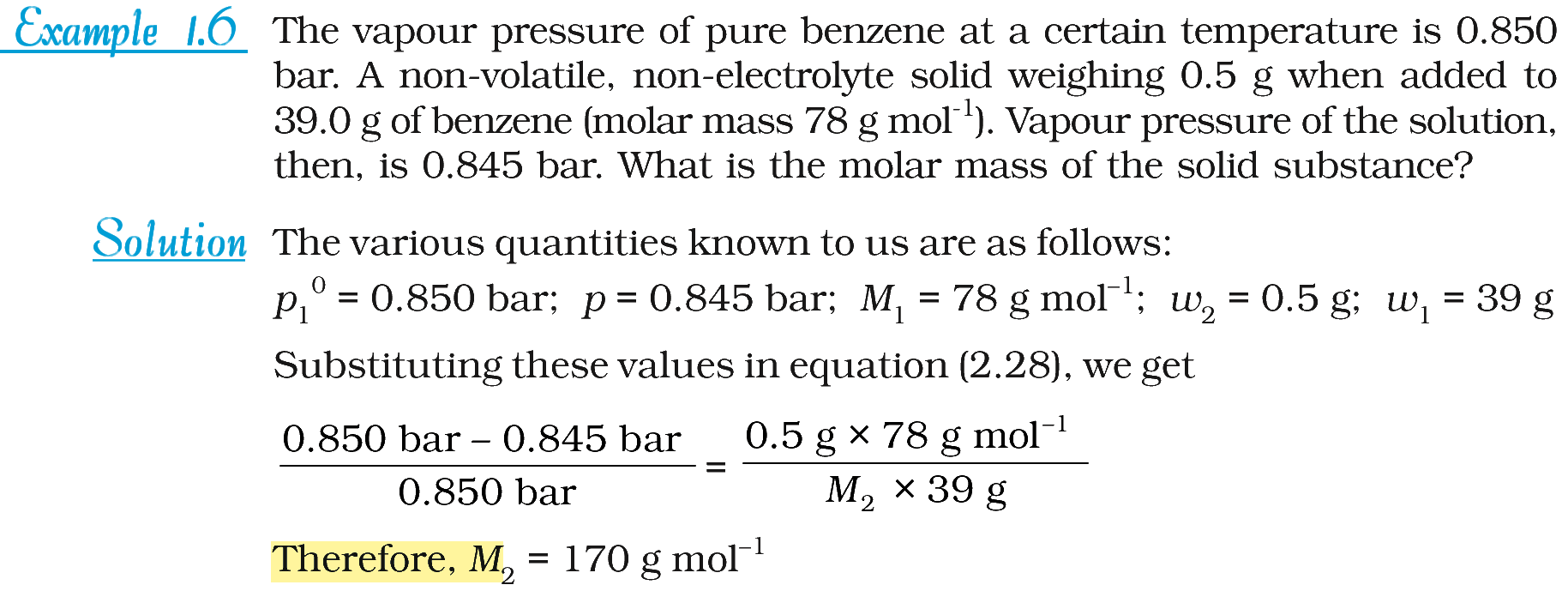
A solution of 0.5 g solute 'X' in 39 g benzene records the vapor pressure as 0.845 bar. The vapour pressure of pure benzene is 0.850 bar. The molar mass of the solute 'X' in g mol-1 is
Assume no association or dissociation takes place in solution.
Answer & explanation
Correct answer: option 3
The correct answer is Option (3) → 170
By Raoult’s law, the relative lowering of vapour pressure of a solvent caused by a non-volatile solute equals the mole fraction of the solute:
\( \displaystyle \frac{p_1^\circ-p_1}{p_1^\circ}=x_2=\frac{n_2}{n_1+n_2} \)
For a dilute solution n2 is very small compared with n1, so:
\( \displaystyle \frac{p_1^\circ-p_1}{p_1^\circ}=\frac{n_2}{n_1}=\frac{w_2\times M_1}{M_2\times w_1} \)
Here w2 = 0.5 g, w1 = 39 g of benzene (M1 = 78 g mol−1), p°1 = 0.850 bar and p1 = 0.845 bar.
\( \displaystyle \frac{0.850-0.845}{0.850}=\frac{0.5\times78}{M_2\times39} \)
\( \displaystyle \frac{0.005}{0.850}=\frac{1}{M_2} \)
\( \displaystyle M_2=\frac{0.850}{0.005}=170\ \mathrm{g\,mol^{-1}} \)
So the molar mass of the solute X is 170 g mol−1.
Shortcut: 0.5 g of solute and 39 g (half a mole) of benzene make w2M1/w1 equal to 1. The molar mass is then p°/(p° − p) = 0.850/0.005 = 170.
Note: This question is from NCERT (2026-27). NTA sets numerical questions from NCERT too, so do not ignore NCERT while practising numericals.
NCERT (2026-27 edition):
Relative Lowering of Vapour Pressure – …