
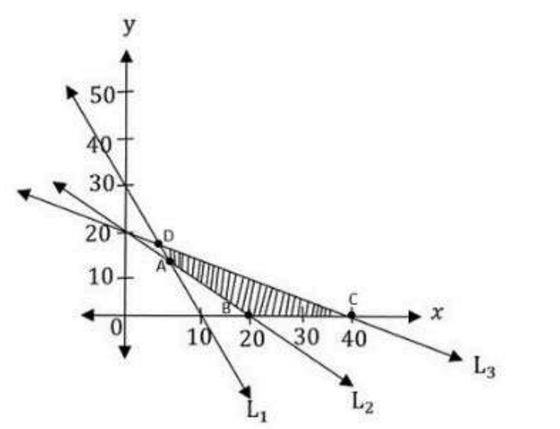
Which one of the following inequalities is redundant for the shaded feasible region (ABCDA) shown below?
Answer & explanation
Correct answer: option 3
The correct answer is Option (3) → \(4x + 3y \le 60\)
A constraint is redundant if removing it does not change the feasible region.
Lines read from the figure:
\(L_1\) through (10, 0) and (0, 30): \(3x + y = 30\)
\(L_2\) through (20, 0) and (0, 20): \(x + y = 20\)
\(L_3\) through (40, 0) and (0, 20): \(x + 2y = 40\)
Corners of the shaded region:
A = \(L_1 \cap L_2\) = (5, 15), B = (20, 0), C = (40, 0), D = \(L_1 \cap L_3\) = (4, 18)
The value of \(4x + 3y\) at the corners:
A: 65, B: 80, C: 160, D: 70
All are at least 60. A linear expression takes its least value on the region at a corner, so \(4x + 3y \ge 60\) holds at every point of the region. The line \(4x + 3y = 60\) does not touch it, so this constraint is redundant.
Why the other options are incorrect
Option (1) \(x + 2y \le 40\) — Incorrect. Its line \(L_3\) forms the side DC.
Option (2) \(3x + y \ge 30\) — Incorrect. Its line \(L_1\) forms the side AD.
Option (4) \(x \ge 0, y \ge 0\) — Incorrect. \(y \ge 0\) forms the side BC, so this pair is not redundant.
Note: It seems that there is a mistake in the original NTA paper, which prints Option (3) as \(4x + 3y \le 60\) when it should read \(4x + 3y \ge 60\). As printed, the region does not satisfy it (C(40, 0) gives 160). The question can still be solved because \(4x + 3y = 60\) is the only line in the options that does not touch the region.