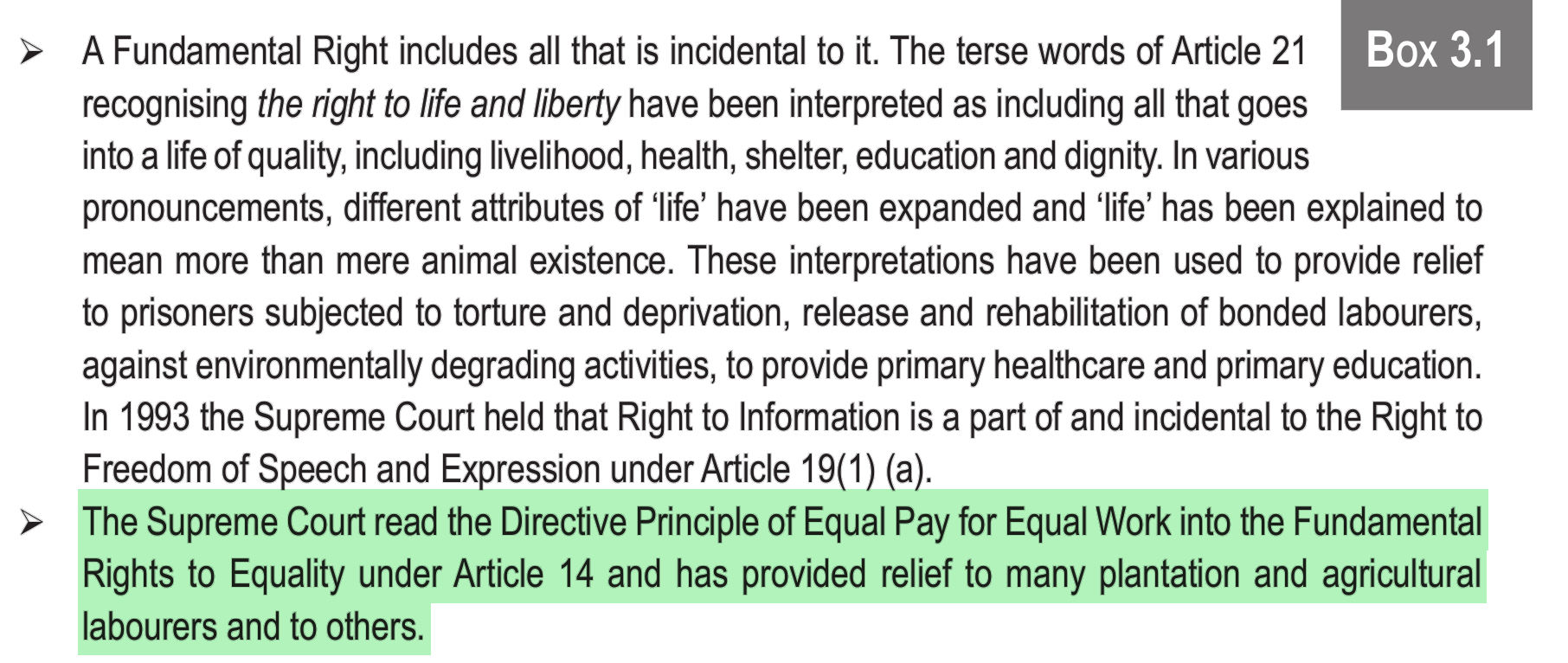
Reading “Equal Pay for Equal Work” into Article 14 shows:
Answer & explanation
Correct answer: option 1
The correct answer is Option (1) → Directive Principles can influence interpretation of Fundamental Rights.
Option (1) Directive Principles can influence interpretation of Fundamental Rights. — Correct. Equal Pay for Equal Work is a Directive Principle. The Supreme Court read it into the Fundamental Right to Equality under Article 14 and gave relief to many plantation and agricultural labourers. A Directive Principle thus shaped how a Fundamental Right is understood, extending the meaning of social justice.
Option (2) The Supreme Court supports caste rules. — Incorrect. Equal pay for equal work removes unequal treatment of workers; it has nothing to do with caste, and caste rules are themselves a form of the inequality Article 14 forbids.
Option (3) Equality is not a constitutional value. — Incorrect. Article 14 is itself the Fundamental Right to Equality; reading equal pay into it makes equality a stronger constitutional value, not a weaker one.
Option (4) Courts cannot use directive principles. — Incorrect. The case itself shows the Supreme Court using a Directive Principle to interpret Article 14.
NCERT: Social Change and Development in India — Chapter 3: The Constitution and Social Change (2025-26)
|