Gause’s “Competitive exclusion principle” is not applicable when:
Answer & explanation
Correct answer: option 3
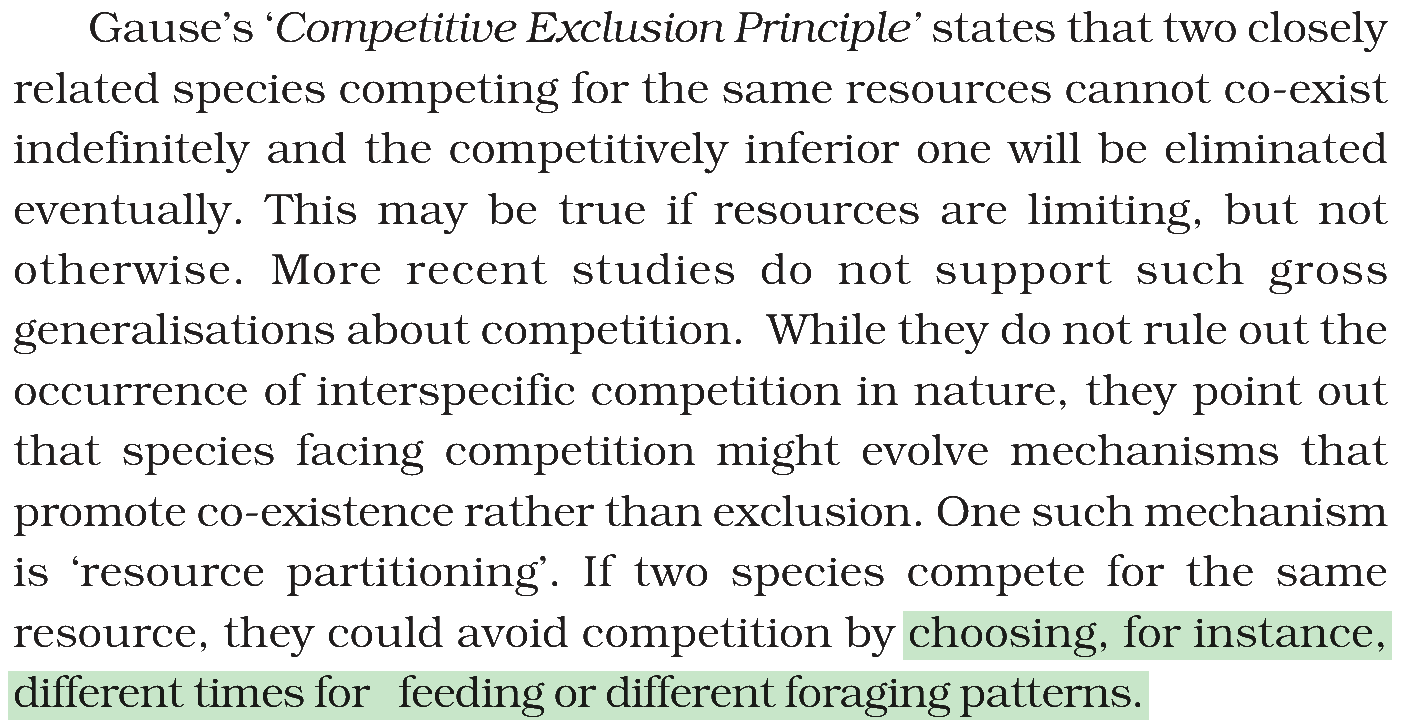
The correct answer is Option (3) → Competing species choose different times for feeding and different foraging patterns
Gause’s Competitive Exclusion Principle says that two closely related species competing for the same resources cannot live together for ever. The weaker competitor is eliminated in the end. This holds when the resources are limiting.
(1) One species is competitively superior and other is competitively inferior — The principle applies. This is the situation in which the inferior one is eliminated.
(2) Resources are limiting — The principle applies. Limited resources are the condition under which it holds.
(3) Competing species choose different times for feeding and different foraging patterns — The principle does not apply. This is resource partitioning. The species avoid competition and live together. MacArthur showed this for five closely related warbler species living on the same tree.
(4) Superior species eliminates the inferior species from an area. — The principle applies. This is the result that it predicts, for example the barnacle Balanus driving out Chthamalus from the intertidal zone.
NCERT Extract:
Population Interactions –